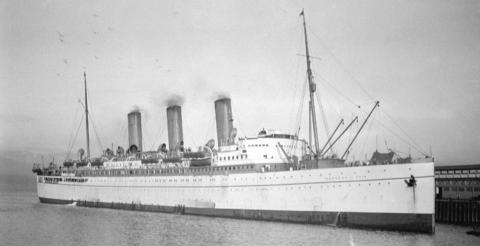
While making the documentary about my family’s restaurant, I did quite a bit of research about my father’s past. I still have some unanswered questions. One is about the ship that brought him and many other Chinese to Canada, The Empress of Asia.
What was the voyage like? I can’t imagine how he felt when, in 1921, as a 13-year-old, he boarded the steamship alone in Hong Kong, heading for a country the Chinese called Gold Mountain. A steerage ticket aboard the Empress of Asia cost approximately $65, a substantial amount for many families at the time. In the movie The Titanic, there are scenes of first-class passengers traveling in luxury while the steerage passengers drink and dance below deck. I wondered if my dad’s experience aboard ship was anything like those scenes. Was he free to roam about or restricted to certain areas of the ship, shunned by other passengers and crew because he was Chinese? One interesting fact I learned is that on the Empress of Asia’s trans-pacific voyages, the vast majority of the ship’s crew were Chinese.
One of the exciting things about doing research is finding a clue. I discovered a website I hadn’t seen before, Empress of Asia – A Canadian Pacific Steamship. This site, hosted by Nelson Oliver, has many interesting facts about the ship and it invites people to submit their own stories about the ship and/or the people who sailed on it. A couple of days after I sent an email explaining that my father had sailed to Canada aboard the Asia, I received a response from Dan Black, author of the book, Oceans of Fate: Peace and Peril Aboard the Steamship Empress of Asia, to be released on February 18, 2025.
Dan kindly answered my questions about what traveling in steerage or Third Class would have been like in 1921. He sent the photo below from W. Kaye Lamb’s book Empress to the Orient (Vancouver Maritime Museum, 1991, p. 109). While it’s not about the Empress of Asia, it gives a good idea of what steerage, (also referred to as “Oriental Steerage”) would have been like.
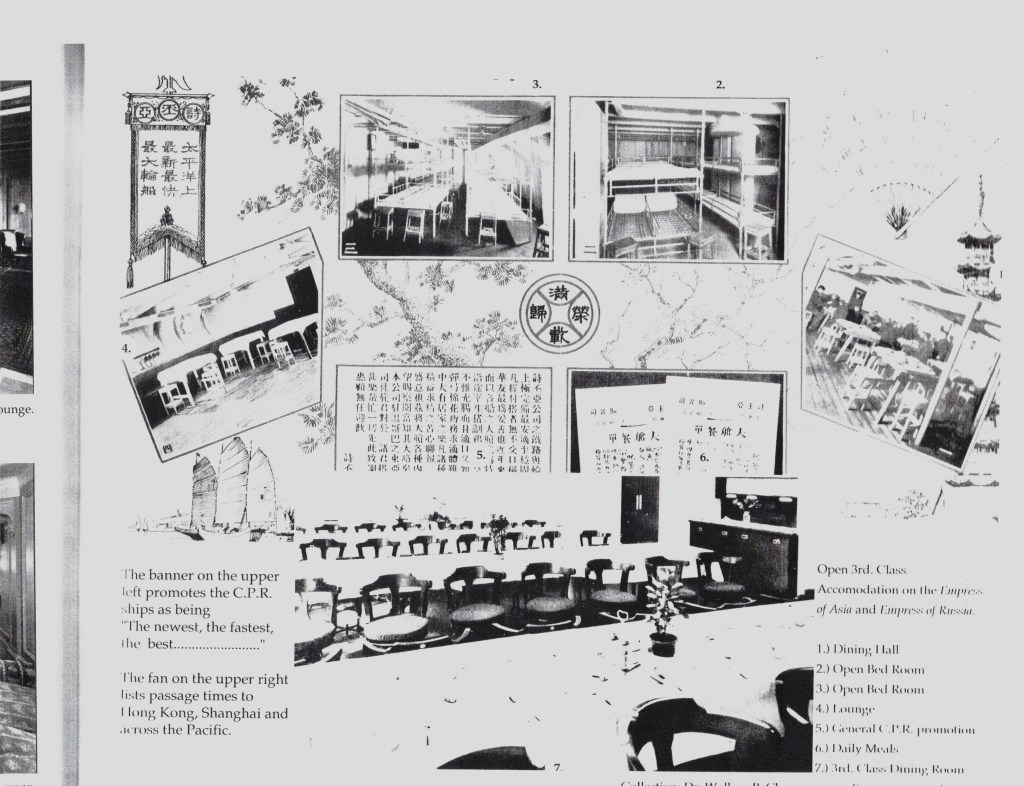
Dan explained:
“On page 194 of my book I describe a young woman descending into the cavernous ship to steerage. Both Nelson and I believe it is important to keep in mind that the Canadian Pacific Ocean Service (CPOS) depended heavily on the business from Chinese passengers travelling to and from North America. Accommodations in steerage on the Empress of Asia were nothing like the horrendous conditions of steerage that existed in the 19th century, especially on the Atlantic. On the Pacific during the time of the Empress of Asia steerage accommodation was comfortable, mostly as a result of the CP’s efforts to sell passage on its passenger ships. The accommodations were far from elegant, but Chinese steerage passengers could move about and there were designated locations where they could get fresh air. Chinese passengers could also travel in Second and Third Class. However, many could not afford it. And as previously noted, Steerage later became Third Class owing to the negative connotations associated with “steerage.”
The sleeping quarters in steerage were rather basic or common and far less private than Second or First Class. Women and families would have had small cabins known as Third Class Closed. To answer your other question, Nelson and I can tell you that races were segregated into separate quarters. This also occurred at quarantine stations after arrival on the west coast.”
The Empress of Asia was a marvel of engineering and design. Commissioned by the Canadian Pacific Railway Company, it was one of the company’s premier ships in the “Empress” line, renowned for their luxury and reliability. Built in 1913 by Fairfield Shipbuilding and Engineering Company in Scotland, it served as a vital link between continents, carrying passengers, cargo, and even soldiers across the oceans.
Dan’s book, Oceans of Fate: Peace and Peril Aboard the Steamship Empress of Asia, will be available for purchase on February 18, 2025.

 Day's Lee