The Empress of Asia: Bringing the Chinese to Canada

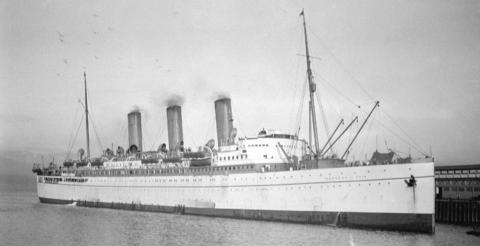
Photo by Robert E. Frost

While making the documentary about my family’s restaurant, I did quite a bit of research about my father’s past. I still have some unanswered questions. One is about the ship that brought him and many other Chinese to Canada, The Empress of Asia.

What was the voyage like? I can’t imagine how he felt when, in 1921, as a 13-year-old, he boarded the steamship alone in Hong Kong, heading for a country the Chinese called Gold Mountain. A steerage ticket aboard the Empress of Asia cost approximately $65, a substantial amount for many families at the time.  In the movie The Titanic, there are scenes of first-class passengers traveling in luxury while the steerage passengers drink and dance below deck. I wondered if my dad’s experience aboard ship was anything like those scenes. Was he free to roam about or restricted to certain areas of the ship, shunned by other passengers and crew because he was Chinese? One interesting fact I learned is that on the Empress of Asia’s trans-pacific voyages, the vast majority of the ship’s crew were Chinese.

One of the exciting things about doing research is finding a clue. I discovered a website I hadn’t seen before, Empress of Asia – A Canadian Pacific Steamship. This site, hosted by Nelson Oliver, has many interesting facts about the ship and it invites people to submit their own stories about the ship and/or the people who sailed on it.  A couple of days after I sent an email explaining that my father had sailed to Canada aboard the Asia,  I received a response from Dan Black, author of the book, Oceans of Fate: Peace and Peril Aboard the Steamship Empress of Asia, to be released on February 18, 2025. 

Dan kindly answered my questions about what traveling in steerage or Third Class would have been like in 1921. He sent the photo below from W. Kaye Lamb’s book Empress to the Orient (Vancouver Maritime Museum, 1991, p. 109). While it’s not about the Empress of Asia, it gives a good idea of what steerage, (also referred to as “Oriental Steerage”) would have been like.
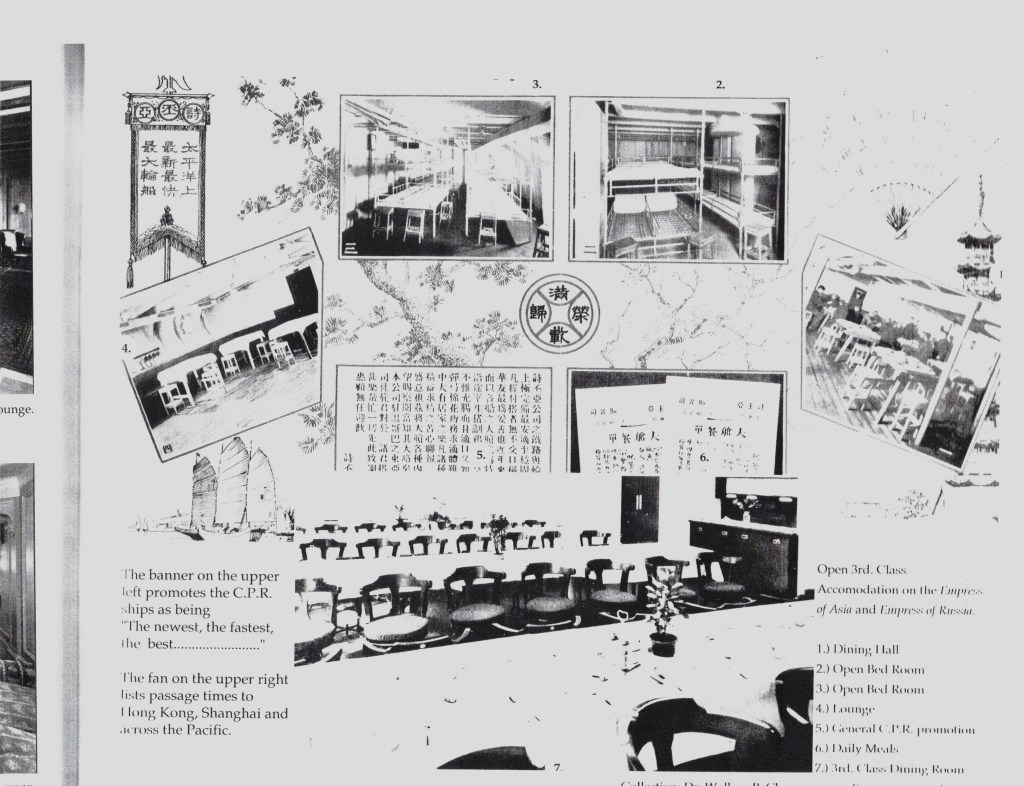
Dan explained:

“On page 194 of my book I describe a young woman descending into the cavernous ship to steerage. Both Nelson and I believe it is important to keep in mind that the Canadian Pacific Ocean Service (CPOS) depended heavily on the business from Chinese passengers travelling to and from North America. Accommodations in steerage on the Empress of Asia were nothing like the horrendous conditions of steerage that existed in the 19th century, especially on the Atlantic. On the Pacific during the time of the Empress of Asia steerage accommodation was comfortable, mostly as a result of the CP’s efforts to sell passage on its passenger ships. The accommodations were far from elegant, but Chinese steerage passengers could move about and there were designated locations where they could get fresh air. Chinese passengers could also travel in Second and Third Class. However, many could not afford it. And as previously noted, Steerage later became Third Class owing to the negative connotations associated with “steerage.”

The sleeping quarters in steerage were rather basic or common and far less private than Second or First Class. Women and families would have had small cabins known as Third Class Closed. To answer your other question, Nelson and I can tell you that races were segregated into separate quarters. This also occurred at quarantine stations after arrival on the west coast.”

The Empress of Asia was a marvel of engineering and design. Commissioned by the Canadian Pacific Railway Company, it was one of the company’s premier ships in the “Empress” line, renowned for their luxury and reliability. Built in 1913 by Fairfield Shipbuilding and Engineering Company in Scotland, it served as a vital link between continents, carrying passengers, cargo, and even soldiers across the oceans.

Dan’s book, Oceans of Fate: Peace and Peril Aboard the Steamship Empress of Asia, will be available for purchase on  February 18, 2025. 

History of Montreal’s Chinese Community at McCord Museum

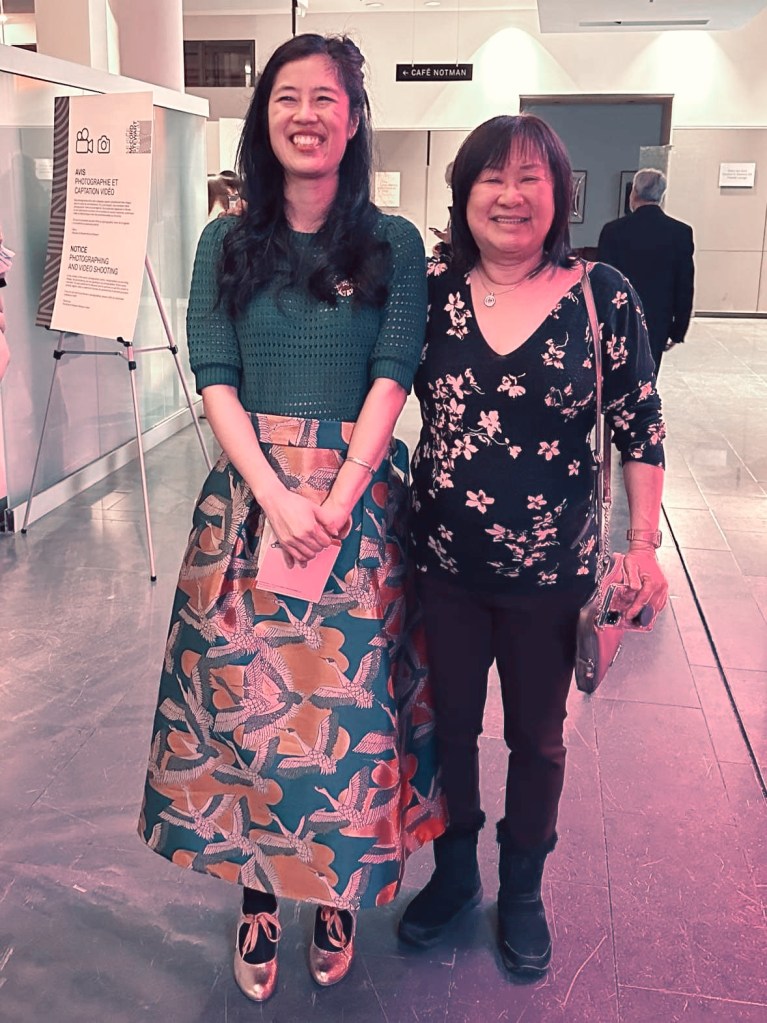
Last night, over 400 people showed up at the VIP event for a preview of Swallowing Mountains, Karen Tam’s exhibit at the McCord Stewart Museum. The wine flowed, speeches were given and then the guests eagerly made their way up to the 3rd floor. It was great to connect with people I hadn’t seen since pre-COVID.

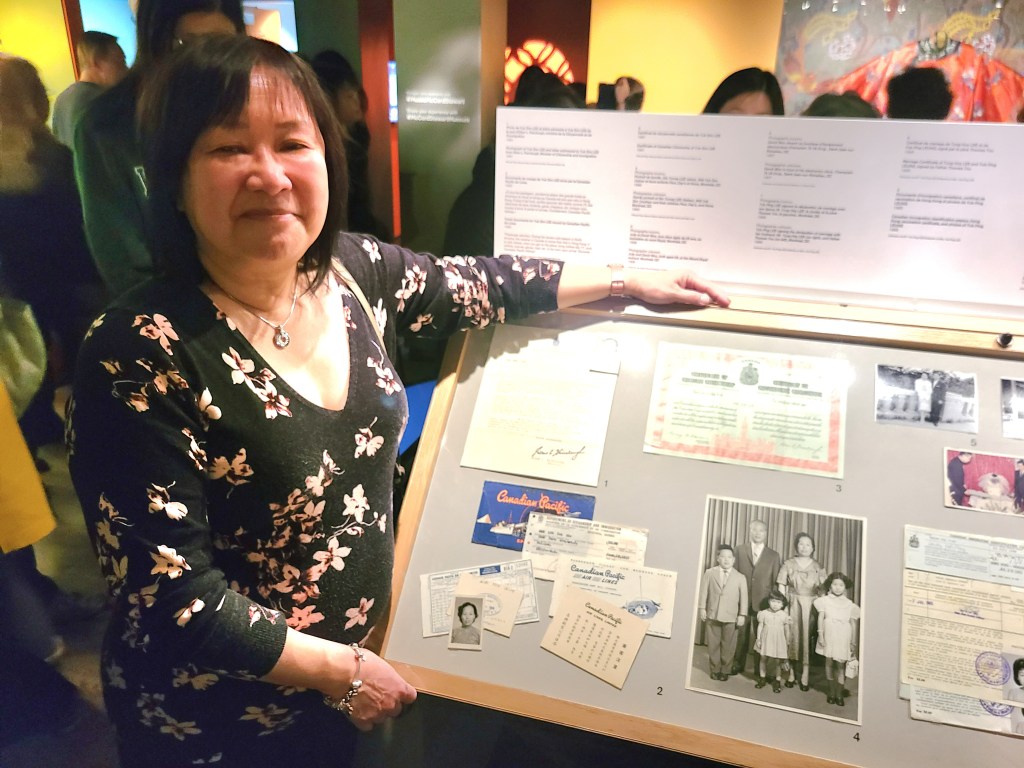
The exhibit is made up of items from the museum’s archives, Karen’s artwork, and photos from families in the Chinese community, including mine. Be sure to pop down to the museum before August 13th and have a look. It’s a great way to learn about Montreal’s Chinese community. https://www.musee-mccord-stewart.ca/en/exhibitions/swallowing-mountains-karen-tam/

Q & A with artist, Karen Tam

I’m very excited about an upcoming exhibit at the McCord Stewart Museum here in Montreal. Karen Tam, who you may remember from my documentary, is currently the museum’s artist-in-residence. Her solo show, Swallowing Mountains, will open to the public starting Friday, February 17th until August 13, 2023. The exhibit focuses on Montreal’s Chinese Community and I’m honored that a small part of my family’s history will be included in the exhibit.

Here is an introduction and a very short Q&A with Karen about the exhibit.

Swallowing Mountains

The year 2023 marks the 100th anniversary of the Chinese Exclusion Act of 1923, which banned virtually all forms of Chinese immigration to Canada. This legislation, along with the head tax levied only on Chinese immigrants and previous patterns of Chinese migration to Canada, resulted in a disproportionately low number of women in Chinese Canadian communities, creating what were known as ‘bachelor societies.’ During the dark period between 1923 and 1947, when the Act was repealed, and up to 1967, when Canadian immigration policy was liberalized, families were separated for decades.

This exhibition offers a counterpoint to the relative silence in public archives and historical narratives regarding Chinese women in Montreal’s Chinatown. An immersive installation, it honours the many women who have lived, worked, and contributed to the neighbourhood over the past 150 years and who, as a group, have been targeted by anti-Asian attacks during the COVID-19 pandemic. The work takes inspiration from objects and materials in the McCord Stewart Museum’s collection, ranging from historical photographs and family albums, to evening coats, restaurant menus, furniture, and Eaton’s ads.

In the 1970s, six acres of Chinatown were expropriated and razed to construct the Complexe Guy-Favreau and Montréal Convention Centre. This exhibition is a way to carve out and reclaim (albeit temporarily) a Chinese space. The alcoves in the gallery function as smaller installations that recall Chinese storefront displays or stage settings, incorporating my sculptures, shadow-puppets, drawings, and textile works. Swallowing Mountains also looks at the disconnect between the bygone popularity of chinoiserie and Japonisme among white women and the reality experienced by Chinese women in Canada since the late 19th century. By including Cantonese opera recordings, collected treasures and photographs lent by family members, elders and friends in the Chinatown community, the exhibition aims to open up conversations around collections and present a model for a future Montreal Chinese Archive.

1) How did you choose what to include in the exhibit?

At the beginning of my residency, I visited the museum’s reserves and collection (from ceramics to textiles to wallpaper samples to toys to furniture, etc.), and also spent a lot of time in the archives/documentation centre, looking through many photographs, family albums, prints, slides, documents, menus, and books. There were quite a number of objects and photographs that I knew had to be in the show. As I developed the project further and conceived of how I wanted the space to look like and be divided, this helped me in deciding what other objects (like the museum’s vases, tables), would work in the space, formally and conceptually. But it was especially difficult to decide which of the photographs from the family albums to include, as they were so fascinating and were taken from the perspectives of the Chinese individuals and families themselves and showed how they saw and presented themselves.

I knew that I wanted to involve the Chinese community in this exhibition and started contacting elders, family members, friends (such as yourself), residents in Chinatown, and through their invaluable help was able to connect with more people and community organizations in and outside Chinatown. They contributed to the project and lent their photographs and artefacts, which supplement items from my own collection, my artworks, and items from the McCord. As I mentioned above this is my proposal for an eventual building of a community archive that also could have a digitized component.

People were so generous and while I tried to include everything that they offered to lend, due to space constraints a number of photographs didn’t make into the physical exhibit (but I made sure to include at least one item per lender in the vitrines). The lenders graciously allowed the museum to digitize or they provided digitized versions of their images and these are viewable on an iPad/tablet next to the community photo vitrines. For many of the lenders, they felt that they never really saw the Chinese Canadian community, themselves, their families, histories and stories reflected in institutions such as the McCord Stewart Museum, and they wanted to support a project that highlights their experiences, especially an exhibition that focuses on Montreal Chinatown and Chinese women.

2) This exhibit, like your other installations, centers on the Chinese-Canadian experience. What does this one mean to you?

Much of my artwork comes out of my research in archives and museum collections. Certain pieces are inspired by specific historical or archival connections, and sometimes it is the materiality and imagery in the collections. At the McCord Stewart, I recognized that there was a gap or underrepresentation of the Montreal Chinese community in the museum’s collections and archives. Not to say there wasn’t any materials, but it made me think about how I could amplify and highlight stories, histories, contributions that did involve this community, especially the women. This exhibit is quite meaningful for me because it is in my hometown and provides an opportunity to do so. Through the exhibition, I hope that visitors will start thinking about the hidden stories and artifacts in their own family and community.

***

As part of the exhibit, on April 5th at 6pm, there will be a screening of Big Fight in Little Chinatown by local filmmaker, Karen Cho. It is a must-see film about how Chinatowns across Canada and in the U.S. are fighting for their survival. There will be a conversation in English between Karen Tam and Karen Cho after the screening. It is free but you must register on the museum’s website. Click on this link and scroll to the bottom of the page.

A First Time Filmmaker at the Yorkton Film Festival

“. . . and the nominees are . . .”

These are four little words that big dreams are made of and I actually got to live it in real life.

Like many film festivals the world over, the Yorkton Film Festival is virtual this year due to the pandemic. Kicking off the festival which is being held from May 27th to 30th was the award ceremony which was streamed live on opening night. My documentary Meet and Eat at Lee’s Garden was nominated in three categories: Research, Multicultural over 30 minutes, and Documentary History and Biography.  

This documentary is my first. Six years ago I had a story idea and I just knew that it had to be a documentary even though I had no experience making one. So just how did it get to be nominated for three of Yorkton Film Festival’s Golden Sheaf Awards?

I think my training and experience as an author had a lot to do with it. For the past two decades, I have been writing and publishing fiction and non-fiction. I’ve attended workshops and conferences on almost every aspect of the business of writing: how to craft stories, do research, how to pitch a story, how to write a synopsis, copyright and more. With a degree in journalism, I already knew how to interview people. Most importantly, I love documentaries. It’s been one of my favorite genres since I was a teenager. And just like the recommendation that anyone who wants to be a writer should read as much as they can, anyone who wants to make documentaries should watch as many as they can.

I figured that the skills I learned as an author would be transferable to film. After all, they are both about storytelling. So I approached filmmaking the same way I write. I found the heart of the story, and then set about to create a beginning, middle and an end, but not necessarily in that order.

It was a ton of work. Maybe even two tons. There were a lot of ups and downs, moaning about who would even watch it (I do the same with my writing “Who would want to read/publish it!?”), evenings spent researching digital libraries for photographs and video footage, checking facts, finding people to interview, transcribing interviews, agonizing over which scenes to keep or cut and figuring out how to change scenes and introduce new characters. I was producer, director and writer and I loved wearing all those hats.

It premiered on the CBC on November 14, 2020, and just like I do at a book launch, I nervously hoped people would like my baby. They did.

So that is how I found myself sitting at my dining table watching the Yorkton Film Festival award ceremony on my laptop anxiously waiting to hear whether my film would win in any of its categories.

It wasn’t a Zoom conference so winners would not give an acceptance speech. The presenters did a nice job of introducing and announcing the awards. To me, it felt like the Academy Awards. Each time they announced one of my categories, I held my breath. The poster flashed across the screen and I was tense with excitement. They announced the other nominees.

And then . . . the winner was someone else.

Of course I was disappointed. The end of that dream is winning the award, but it still feels really good just to have been nominated. This is so much more than I expected for my first documentary.

My congratulations to Captive produced by Antica Productions for winning the award for Research, The Artics produced by Midnight Light Media for winning Multicultural 30 Minutes and Over, and to Mr. Emancipation: The Walter Perry Story produced by The Walter Perry Freedom Foundation for winning Documentary History and Biography. I’m looking forward to watching these films.

It ain’t over folks. Meet and Eat at Lee’s Garden was selected by the Austin Asian American Film Festival which runs from June 4-20, 2021. It was rejected by a handful of other film festivals but I’m expecting a response from 17 others throughout the year.

I’ll keep you posted.

If you’re in Canada, you can watch Meet and Eat at Lee’s Garden on CBC through their GEM app.

The Story Behind Chinese-Canadian Restaurants

I have only written a couple of posts about my family. There is the one about celebrating Christmas An Old-Fashioned Chinese-Canadian Christmas and one about eating out with my dad in a Chinese restaurant The Writing on the Wall: Ordering a Chinese Meal. A few years ago, I decided that I wanted to tell a bigger story and in a way that I had never done before. It took me six years, but I finally finished my first documentary.   

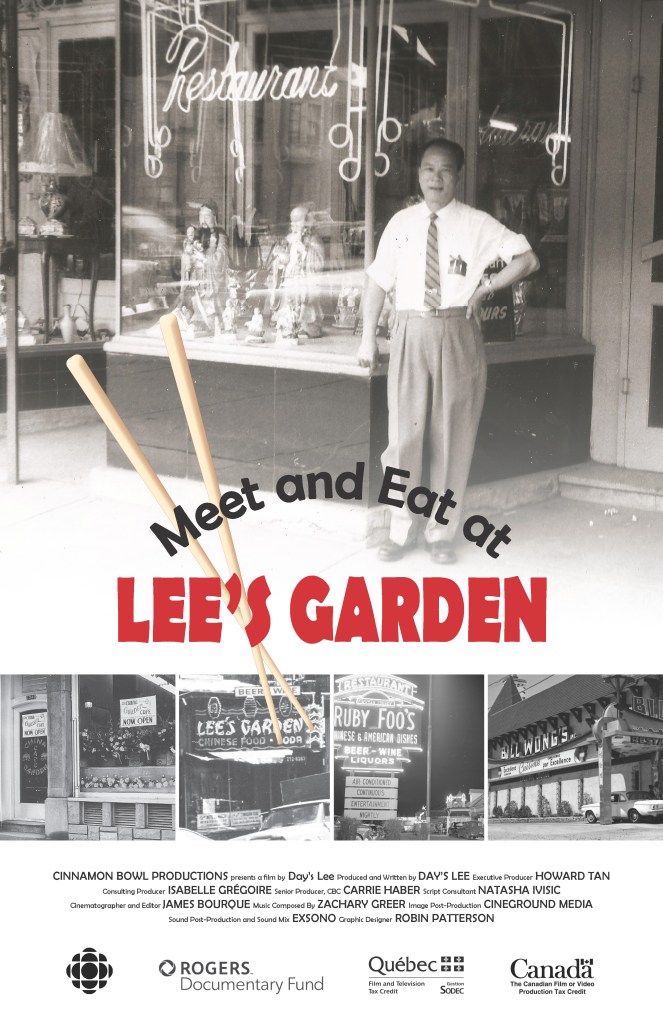
Meet and Eat at Lee’s Garden takes a look at Chinese-Canadian restaurants in the 1950s, the men who owned them and what the restaurants meant to the Chinese and Jewish communities.

 Working in restaurants as a cook, waiter or owner defined a generation of head-tax payers including my father who opened Lee’s Garden on Park Avenue in 1951.

The 1950s was a time of change for the Chinese community. The Chinese Immigration Act was repealed by parliament and the men who had lived in Canada for decades were finally allowed to become Canadian citizens and bring their wives and children to Canada.

The restaurants allowed a relationship between the Chinese and their customers that would not have occurred outside of the restaurants. Those early pioneers were the face of the Chinese community. They made contact with a society that considered them outsiders. By opening their doors and welcoming everyone who entered, other marginalized communities, such as the Jewish community, found acceptance.

In the 1950s, for the Jewish community, the fact that Chinese restaurants were open seven days a week meant they could have family dinners on Sunday, when other restaurants were closed. This brings up the question of why Jewish people eat Chinese food made with pork. The answer is Safe Treyf, the logic by which a Jewish person can eat the pork in Chinese food.

The Chinese-Canadian restaurant and its distinctive menu have earned a place in history and in people’s hearts. Upon closer examination, they also tell the story of the struggle of the Chinese to be accepted in Canada, of Chinese families who were separated for decades because of a racist government policy, and the food that has created a bond between the Chinese and Jewish communities that continues to this day.

My documentary, Meet and Eat at Lee’s Garden, will premiere on CBC on Saturday, Nov. 14, 2020 at 7p.m. on the show Absolutely Canadian. It will also be available for streaming on the internet (in Canada only) with the CBC GEM app.

Why is that Cat in the Window and Other Things You Might Ask About Asian Heritage Month

Asian Heritage Month 2018 at Children's World Acacemy

See the statue of the cat that I’m holding? You may recognize it if you frequent Asian establishments. It’s usually near the cash register or in the window of the store. I discovered the meaning of why the cat has one paw raised while I was doing a presentation for Asian Heritage Month at Children’s World Academy last Friday. My friend and co-presenter, Walter, explained that the cat is beckoning people to enter the store. The cat is holding a coin in its other paw, a sign that people should enter and spend money. It was as much a revelation to me as to the kids.  Continue reading

The Giants are in Montreal

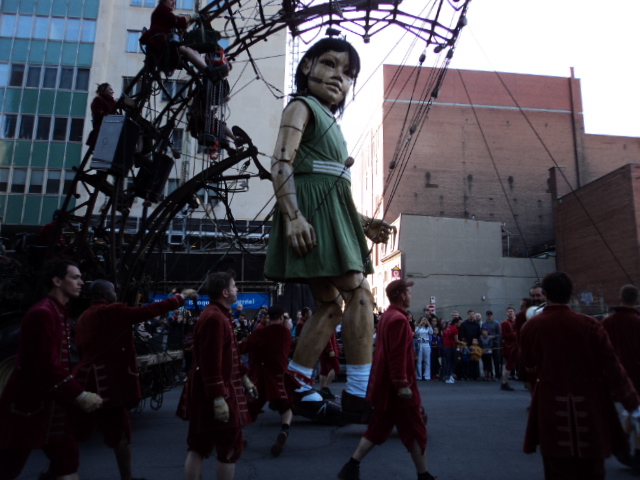
There are some huge celebrities here to celebrate Montreal’s 375th birthday, and I really mean huge.

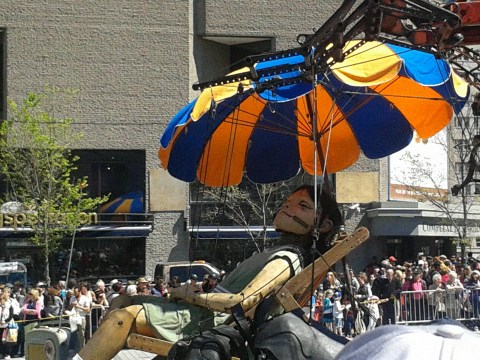
The Giants are in town for the weekend. Not the football team. The Giants of the Royal De Luxe company are marionettes from France. There are three of them: The Sea Diver which is the largest, a Little Girl, which is the diver’s niece, and her dog. This is their first appearance in Canada.

DSC07633

It takes a lot of people to manipulate them and watching them work is as fascinating as the marionettes themselves.  Continue reading

Books to Read in 2017

I’m not good at keeping New Year’s resolutions. I’m one of those who forgets/gives up a couple of weeks into the New Year or I’ll procrastinate and start the resolution when tulips are blooming, maybe. (What’s the rush? There’s 365 days in the year.) But this year will be different. I will not procrastinate as this resolution will be easy to keep: I resolve to read more. Continue reading

Montreal Celebrates the Year of the Rooster

I dropped by Chinatown this afternoon where the celebrations for the New Year were taking place. The Montreal Chinese Lion Dance Club was performing the ritual dance in front of various stores in Chinatown to wish them luck and good fortune for the new year. Here’s a short clip.

I wish you all good fortune for the Year of the Rooster!