Chinese Tea Salon in Montreal

A couple of weeks ago, I received an e-mail invitation to a Chinese Tea Salon. The invitation explained that the event was “to meet, eat, drink and exchange about diverse projects in the arts, community and academic sectors. This gathering is inspired from tea houses in China (茶館, cháguăn or 茶屋, cháwū ) traditionally similar to the America Café, but centred on tea and to chat, eat and socialize.”

It sounded interesting and it was potluck. I bought mini chocolate chip muffins at the grocery store after work and headed over to the Simone de Beauvoir Institute at Concordia University where the salon was being held.

The tea salon was inspired by Montreal artist Mary Wong who has been organizing tea houses for visual artists. This evening, which was organized by Janet Lumb and moderated by Alice Ming Wai Jim, an Associate Professor of Contemporary Art at Concordia University, was an opportunity for Montrealers to talk about their projects.

It was a fascinating evening. Each speaker had an interesting angle on their research and artistic project:

  • Olive Li Hui, a visiting professor, teaches a course about Chinese-Canadian women writers at Sichuan University in China;
  • Tracy Zhang explained how acrobatics is used as an instrument of cultural diplomacy in Taiwan and China;
  • Alan Wong spoke of race and sexuality;
  • Cheryl Sim, a media artist, talked about her project exploring the relationship women have with the cheong sam;
  • Parker Mah presented a trailer for his documentary Être Chinois au Québec (Being Chinese in Quebec). You can see a trailer on Youtube or at Être Chinois au Québec.net 
  • Leslie Cheung, a PhD student, talked about youth of color, the second generation and their search for identity;
  • Joanne Hui asked and answered the question “How does art teach?”
  • Henry Tsang, an associate professor at Emily Carr University in Vancouver, B.C., gave an impromptu talk on what it is to be Chinese;
  • And yours truly gave a brief talk about the inspiration behind my writing.

I wouldn’t be able to do justice to the speakers by trying to explain their projects, but a five minute video tape of each presenter, including me, will be available soon on the Asian Canadian Wiki site. I’ll post it when its available. To read more about the presenters and the evening itself, click here.

A Cowherd in Paradise

DSC02842

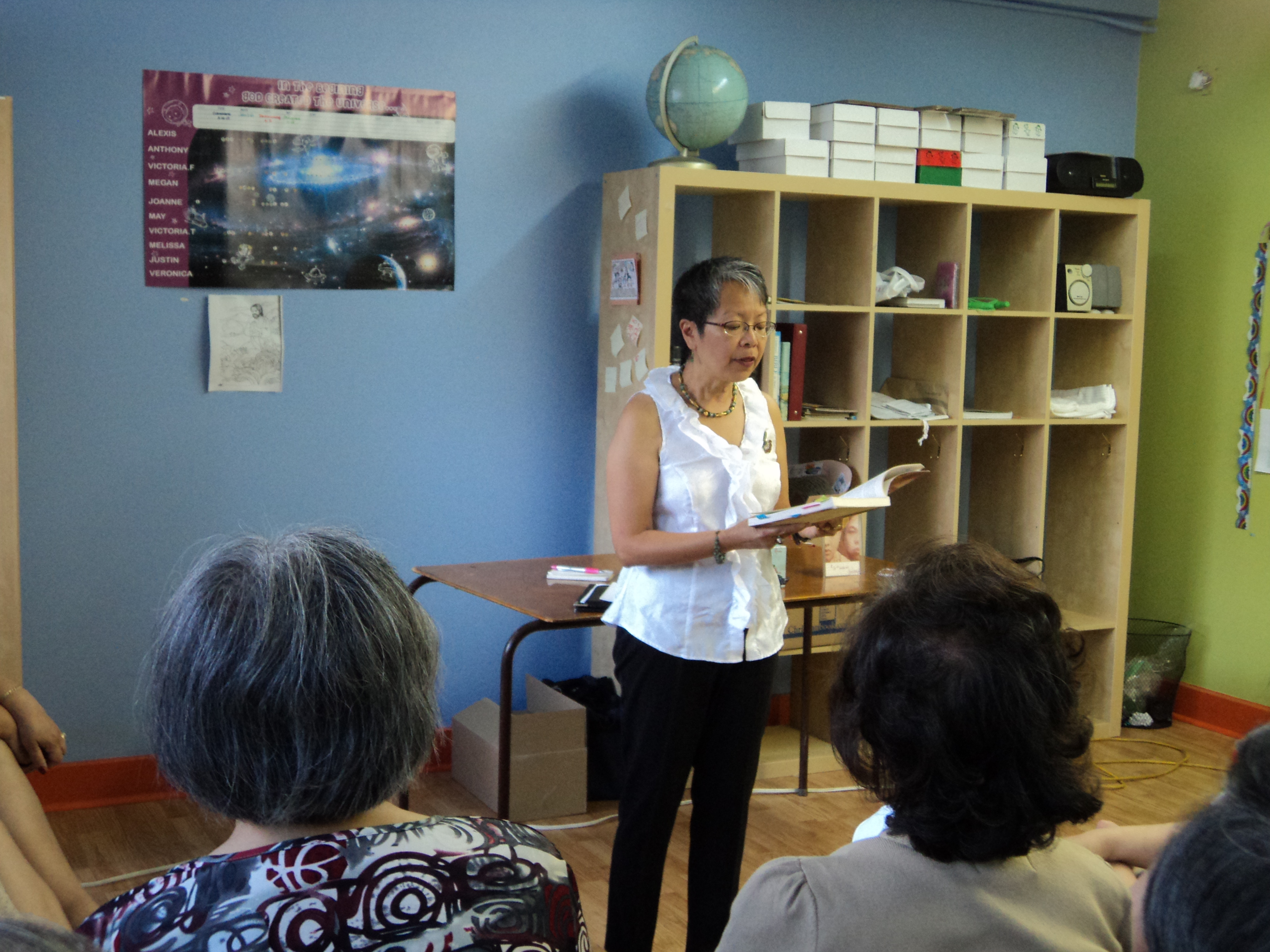
May Wong reads from her book, “A Cowherd in Paradise: From China to Canada”

When a friend e-mailed me that May Wong was coming to Montreal to do a reading this past Sunday, I knew I had to go. Her book, “A Cowherd in Paradise: From China to Canada” is about her parents who were separated for years because of Canada’s Exclusion Act which came into law in 1923. My parents story sounded similar to hers and so I went eager to hear what she had to say.

Wong had the audience’s rapt attention as she set the background for her story, explaining the historical details that shaped her parents’ lives. Her father chose her mother from a picture. Her mother didn’t know what her future husband looked like until after the wedding ceremony.  While her father was establishing himself as a restaurateur in Montreal, her mother was in China stuggling to survive natural disasaters and the Japanese invasion. The title of the book is a tribute to her mother who was responsible for the family’s water buffalo when she was a little girl. The book includes old family photos and a copy of her father’s head tax certificate.

While I haven’t read the book yet, I think it would be interesting for those whose parents, like mine, didn’t talk about the past. It is very fortunate that Wong’s mother, not only wanted to tell her stories, but also wanted Wong to publish them. The book is a treasure not only for Wong’s family, but for families of other head-tax payers as well.

The Long Voyage: From Pigtails and Coolies to the New Canadian Mosaic

The Long Voyage: From Pigtails and Coolies to the New Canadian Mosaic

Years ago, when I decided to see if I had the stuff to be a writer, I took a creative writing course at a Continuing Education program at Concordia University. The teacher, to inspire us, told us to write what we know. It sounded simple, and I’ve heard that piece of advice many times since, but I had difficulty because I didn’t think people would be interested in what I knew. I ended up writing a short story based on my experience of working in my family’s restaurant which was eventually published as a children’s picture book, The Fragrant Garden. Since then, I’ve written several stories, both fiction and non-fiction about the Montreal Chinese Community. It’s a way for me to learn about its history as well as my family’s history. My father was  a head tax payer. He was 13 years old when he landed in Vancouver on November 28, 1921 and paid $500 to enter Canada. He never said much about his past, so when I do research, I can only imagine what his story is about.

Now there is an educational website, The Long Voyage: From Pigtails and Coolies to the New Canadian Mosaic, about that period in Canadian history and the history of the Montreal Chinese Community. It has video interviews with descendants of head tax payers and an overview of the history of the Chinese in Canada. Anyone who is interested in Canadian history or the history of head tax payers will find this site useful and informative. It might also spark some interesting conversations in some families.

No Longer a Foreigner

In celebration of Canada Day, I’m posting an article I wrote that was published in the December 2005 issue of Concordia University Magazine.

Happy Canada Day, everybody!

I was born and educated in Montreal, but while I was growing up, and for many years thereafter, people asked me where I was from, no matter how well I spoke English and French. Experience taught me that exotic looks in this country meant one was a foreigner.

Times have changed. I was at a social event with a number of strangers when someone asked, “Where are you from?” I was about to reply when I realized the question wasn’t directed at me: it was aimed at a friend who was standing beside me, Jane, a woman with peaches-and-cream complexion, brown eyes and short, wavy hair. At a glance, nothing about her screams “foreigner.” However, when she speaks, her British accent rings out strong and clear. New acquaintances immediately take note, and Jane’s origins quickly become the topic of conversation. It’s a situation I find amusing, especially when I’m standing next to her. My oriental looks don’t pique their interest. Have I finally achieved Canadian nirvana?

When I was a young girl, I was often complimented on my mastery of the English language. Even though I didn’t have a Chinese accent, people assumed I was a recent immigrant. I imagine they took their cue from my parents, who emigrated from China in the first half of the 1900s. My father had taught himself English and my mother barely spoke it at all. If I spoke French, people were certain I was Vietnamese. It was the only possible explanation.

Occasionally, I met people whose knowledge of Chinese history and culture exceeded mine. They spoke of the Ming Dynasty or the Tang Dynasty as if I, too, were a student of Ancient China. I listened in silence, too embarrassed to admit the only dynasty I knew of starred Joan Collins and Linda Evans.

Curious glances often turned into polite inquiries. Questions about my birthplace were a common occurrence. I wondered why I had to explain it at all. So, I decided to turn the tables on my inquisitors and asked about their own background. I was surprised and pleased to learn that most of them came from elsewhere. We often fell into pleasant conversations about the food we ate, the sound of our language and traditions. Being different, I discovered, is interesting.

Jane has been in Canada for almost 20 years now. She doesn’t mind if people are curious about her birthplace, but here have been times when she wished she wasn’t asked as soon as she said “Hello.”

Another friend, Cathy, who arrived from England about 25 years ago, gets a bit mischievous with people who are charmed by her speech. She switches her northern inflection into a Cockney accent, and peppers the conversation with British expressions.

“People love it,” Cathy says, about the feedback to her use of colourful jargon. Even though people respond positively to her accent, she swears she’s lost most of it. Whenever she goes back to England for a visit, her family and friends tell her she sounds Canadian.

It’s been years since simply being Chinese elicited curious glances from strangers. The road to get to where my ethnicity is overlooked was a long one. Decades ago, before it was politically incorrect, people openly voiced their objections to the influx of “yellow foreigners.” Back then, every so often, kids and even some adults would fling open the door to my family’s restaurant and yell, “Go back home to China!” and then run off. My parents patiently shook their heads at such behaviour. As a child, I thought such cries were ridiculous. I had never even been to China, so how could it be my home?

On the other hand, years later when I travelled to the Orient as an adult, I stood out as foreign as well, a Canadian. Once, I was wandering one of the busy shopping districts of Hong Kong and attempted to communicate with the locals. We always started off trying to figure out what dialect we each spoke, but it didn’t matter as I always ended up asking if they spoke English.

The day has finally arrived where I blend in with the general population, and that may be in part due to the fact that the general population has changed. The Chinese are now the largest visible minority group in Canada. Living in a metropolitan city like Montreal, with its large Asian population, makes being Chinese less of a phenomenon.

Over the years, though, the question itself has changed, and so has the tone. It’s no longer one of whether or not I belong here. Instead of assuming I immigrated to Canada, people now ask what nationality I am. It’s a question I’m happy to answer, and ask in return. Taken in the right light, it’s a question that acknowledges the many ethnic groups that make up Canada’s population. In a country populated by immigrants, looking different is now the norm.