Double Chinese Happiness

Have you ever had trouble ordering from a Chinese menu? This blog will make you smile.

Browsing the Atlas's avatarBrowsing The Atlas

Rarely has one meal made so many people happy.

Last week, our tour guide pointed out a red-lanterned street known as “Ghost Street” and said that it was a famous area for spicy dishes, hot pot, and Sichuan food. We were in a minibus at the time, but my husband and I decided that we’d go back and check it out. At 3:00 the next afternoon, we did.

DSCN1528

We were fooled by the menu posted outside one restaurant that had pictures of food labeled in English. It seemed like a good choice so we went in.

The young woman serving us came over with a very detailed order sheet; the kind you typically see in a sushi place. But this one was entirely in Chinese characters. There wasn’t a word of English anywhere on it and we had no idea what to do with it.

She stood at our table…

View original post 439 more words

Lee’s Garden Dry Garlic Spare Ribs

When I was a kid, my parents owned a Chinese-Canadian restaurant called Lee’s Garden. It was located on Park Avenue near Laurier Avenue in Montreal. I started working there on weekends when I was in elementary school, helping my mother make egg rolls or bagging take-out orders. By the time I was in high school, it became a full-time summer job. I answered the phone and handled the cash register. The restaurant was like a second home. The waiters and cooks became extended family and regular customers became old friends.

Then one day my parents told me something that shocked me to the core.  Nothing on the menu was real Chinese food, they said. The butterfly shrimps, chicken chow mein, pineapple chicken, and everything else was invented for the ghosts, the red-haired devils. The news hit me like a lightning bolt. How could that be? Chicken Soo Guy, won ton soup and egg rolls were my comfort food! They were fake?! If the food was fake, then what did I know about being Chinese?

The restaurant’s most popular dish and one of my favourites (and still is) was Dry Garlic Spare Ribs. The tender, melt off the bone ribs with the sweet, sticky sauce was on almost every order. The recipe is one of the few things I have left of the restaurant and I’ve decided to share it with those who made the restaurant a welcoming place, a place where Sunday dinners became a part of their family traditions, where special occasions were celebrated and where the regulars dropped by for a cup of coffee, a piece of pie and friendly banter. You. The public.

Lee’s Garden closed in the early 1970s, but it remains forever in my heart. If you or anyone you know frequented the restaurant, please write a comment. I’d love to hear your story.

Lee's Garden Dry Garlic Spare Ribs

Lee’s Garden Dry Garlic Spare Ribs

(A Chinese-Canadian classic)

 3 lbs. pork spare ribs

3 cloves of finely chopped garlic

1 1/2 tsp. soy sauce

1 to 2 quarts boiling water

1 tsp. salt

3/4 cup white sugar

  1. Wash and cut the ribs into bite size pieces. Trim excess fat.
  2. Heat a large frying pan or wok on medium high heat. DO NOT ADD ANY oil, butter or margarine as this will produce an oily film on the ribs.
  3. Stir fry ribs until they are an even light brown color. Keep stirring to prevent the meat from sticking to the pan. Drain the juice from the pan.
  4. Add garlic and continue to stir fry for five minutes.
  5. Sprinkle the soy sauce over the ribs and continue stir frying on medium for about 3 to 4 minutes.
  6. Pour boiling water into the pan until the water just covers the ribs.
  7. Sprinkle the salt over the ribs and stir. Cover and boil on medium high for 10 minutes.
  8. Add sugar, distributing it evenly over the ribs. Cover and boil on medium for 20 minutes.
  9. The ribs should be very tender. If not, continue to boil for a few more minutes.
  10. The sauce should be thick and brown. If it is still too watery, leave the cover off, allowing some of the water to evaporate. If the sauce is too thick, add a bit of boiling water.

No Longer a Foreigner

In celebration of Canada Day, I’m posting an article I wrote that was published in the December 2005 issue of Concordia University Magazine.

Happy Canada Day, everybody!

I was born and educated in Montreal, but while I was growing up, and for many years thereafter, people asked me where I was from, no matter how well I spoke English and French. Experience taught me that exotic looks in this country meant one was a foreigner.

Times have changed. I was at a social event with a number of strangers when someone asked, “Where are you from?” I was about to reply when I realized the question wasn’t directed at me: it was aimed at a friend who was standing beside me, Jane, a woman with peaches-and-cream complexion, brown eyes and short, wavy hair. At a glance, nothing about her screams “foreigner.” However, when she speaks, her British accent rings out strong and clear. New acquaintances immediately take note, and Jane’s origins quickly become the topic of conversation. It’s a situation I find amusing, especially when I’m standing next to her. My oriental looks don’t pique their interest. Have I finally achieved Canadian nirvana?

When I was a young girl, I was often complimented on my mastery of the English language. Even though I didn’t have a Chinese accent, people assumed I was a recent immigrant. I imagine they took their cue from my parents, who emigrated from China in the first half of the 1900s. My father had taught himself English and my mother barely spoke it at all. If I spoke French, people were certain I was Vietnamese. It was the only possible explanation.

Occasionally, I met people whose knowledge of Chinese history and culture exceeded mine. They spoke of the Ming Dynasty or the Tang Dynasty as if I, too, were a student of Ancient China. I listened in silence, too embarrassed to admit the only dynasty I knew of starred Joan Collins and Linda Evans.

Curious glances often turned into polite inquiries. Questions about my birthplace were a common occurrence. I wondered why I had to explain it at all. So, I decided to turn the tables on my inquisitors and asked about their own background. I was surprised and pleased to learn that most of them came from elsewhere. We often fell into pleasant conversations about the food we ate, the sound of our language and traditions. Being different, I discovered, is interesting.

Jane has been in Canada for almost 20 years now. She doesn’t mind if people are curious about her birthplace, but here have been times when she wished she wasn’t asked as soon as she said “Hello.”

Another friend, Cathy, who arrived from England about 25 years ago, gets a bit mischievous with people who are charmed by her speech. She switches her northern inflection into a Cockney accent, and peppers the conversation with British expressions.

“People love it,” Cathy says, about the feedback to her use of colourful jargon. Even though people respond positively to her accent, she swears she’s lost most of it. Whenever she goes back to England for a visit, her family and friends tell her she sounds Canadian.

It’s been years since simply being Chinese elicited curious glances from strangers. The road to get to where my ethnicity is overlooked was a long one. Decades ago, before it was politically incorrect, people openly voiced their objections to the influx of “yellow foreigners.” Back then, every so often, kids and even some adults would fling open the door to my family’s restaurant and yell, “Go back home to China!” and then run off. My parents patiently shook their heads at such behaviour. As a child, I thought such cries were ridiculous. I had never even been to China, so how could it be my home?

On the other hand, years later when I travelled to the Orient as an adult, I stood out as foreign as well, a Canadian. Once, I was wandering one of the busy shopping districts of Hong Kong and attempted to communicate with the locals. We always started off trying to figure out what dialect we each spoke, but it didn’t matter as I always ended up asking if they spoke English.

The day has finally arrived where I blend in with the general population, and that may be in part due to the fact that the general population has changed. The Chinese are now the largest visible minority group in Canada. Living in a metropolitan city like Montreal, with its large Asian population, makes being Chinese less of a phenomenon.

Over the years, though, the question itself has changed, and so has the tone. It’s no longer one of whether or not I belong here. Instead of assuming I immigrated to Canada, people now ask what nationality I am. It’s a question I’m happy to answer, and ask in return. Taken in the right light, it’s a question that acknowledges the many ethnic groups that make up Canada’s population. In a country populated by immigrants, looking different is now the norm.

Interview: Lenore Look

Colby Sharp's avatarsharpread

I’m sure that many of your share my love for Alvin Ho. He’s one of the most unique characters in children’s literature that I have ever read. Getting the opportunity to interview Alvin Ho author, Lenore Look, is an honor. I’m hoping that you enjoy the interview, and that you check out her beautiful picture book Brush of the Gods.

BRUSH OF THE GODS_cover image

My students and I study legends and myths as part of our fourth grade curriculum. I am excited to add The Brush of the Gods to our arsenal. Can you talk about how your Chinese heritage has informed her work on this book?

I grew up listening to my dad tell tall tales about growing up in China, and about Chinese historical figures and events that really sparked his imagination. He knew the cold, hard facts, but the way he told them to us always sounded like a first-hand account. For…

View original post 549 more words

Cultural Routes

DSC02571

Montreal’s CN Station

The St-Jean Baptiste long weekend is coming up and many people will be planning a short getaway to enjoy the three-day-weekend. With the spirit of travel in mind, I’m posting an article I wrote about a train ride I took to Toronto that was first published in Canadian Living magazine, November 1997.

* * *

As I waited to board the train from Montreal to Toronto, a Chinese man approached me and, speaking in broken English, asked if I were going to Union Station. Wary of strangers who ask about my travel plans, I hesitantly nodded yes. “Could you look after her?” he asked, gesturing toward a petite, well-dressed woman of about fifty. “She doesn’t speak any English.” Smiling shyly, she bowed.

“I don’t speak much Chinese,” I warned, realizing he’d chosen me because I was the only Oriental in line.

“It’s OK. Thank you,” he said, and left after a quick goodbye to the woman. We boarded the train and sat together. She slept. I read until the steward appeared pushing the lunch cart.

I’m bilingual: I speak both French and English, but my Chinese is very limited. Stumbling over my mother tongue, I asked if she wanted something to drink.

I understood her Cantonese reply, “Apple juice.” So far, so good. Then came the menus.

“Do they have rice?” she asked as I scanned the list.

“No rice,” was all I could manage. I ordered apple juice.

She pointed to a drawing of a pizza. “Bread?”

“Ye-e-ss.” What was the translation for tomato sauce? “It has tomatoes.” Picking up a pizza slice from the cart, I showed it to her. The thick sauce did not resemble tomatoes in the least. She frowned. I showed her the menu, hoping she would recognize something. Surely, “Chicken Sandwich” was universal. She pointed to another drawing. “Is that bread?”

“Un, no. It’s sweet. A ma-a-fin.” I regretted it the instant I said it. Saying muffin with a Chinese accent is as ludicrous as assuming a foreigner will understand English if it’s spoken slowly and loudly enough. The steward looked amused as he handed me a muffin for her inspection. “How about Pita Pockets?” he suggested.

“Oh, I couldn’t explain that in Chinese,” I groaned. Finally, she decided on pizza, insisting we share the large slice. Quiet settled between us as we ate. She cut the pizza into pieces and hesitantly tasted each one. After we finished, she pulled out a small bag containing toothpicks and offered me one. I accepted.

We attempted more conversation. I strained to understand as she talked about her visit to Canada. She giggled as I formed awkward phrases. We carried on this way and somehow it didn’t matter that I had forgotten so much Chinese. In the end, we understood each other perfectly.

The Ancestral Ceremony

Image

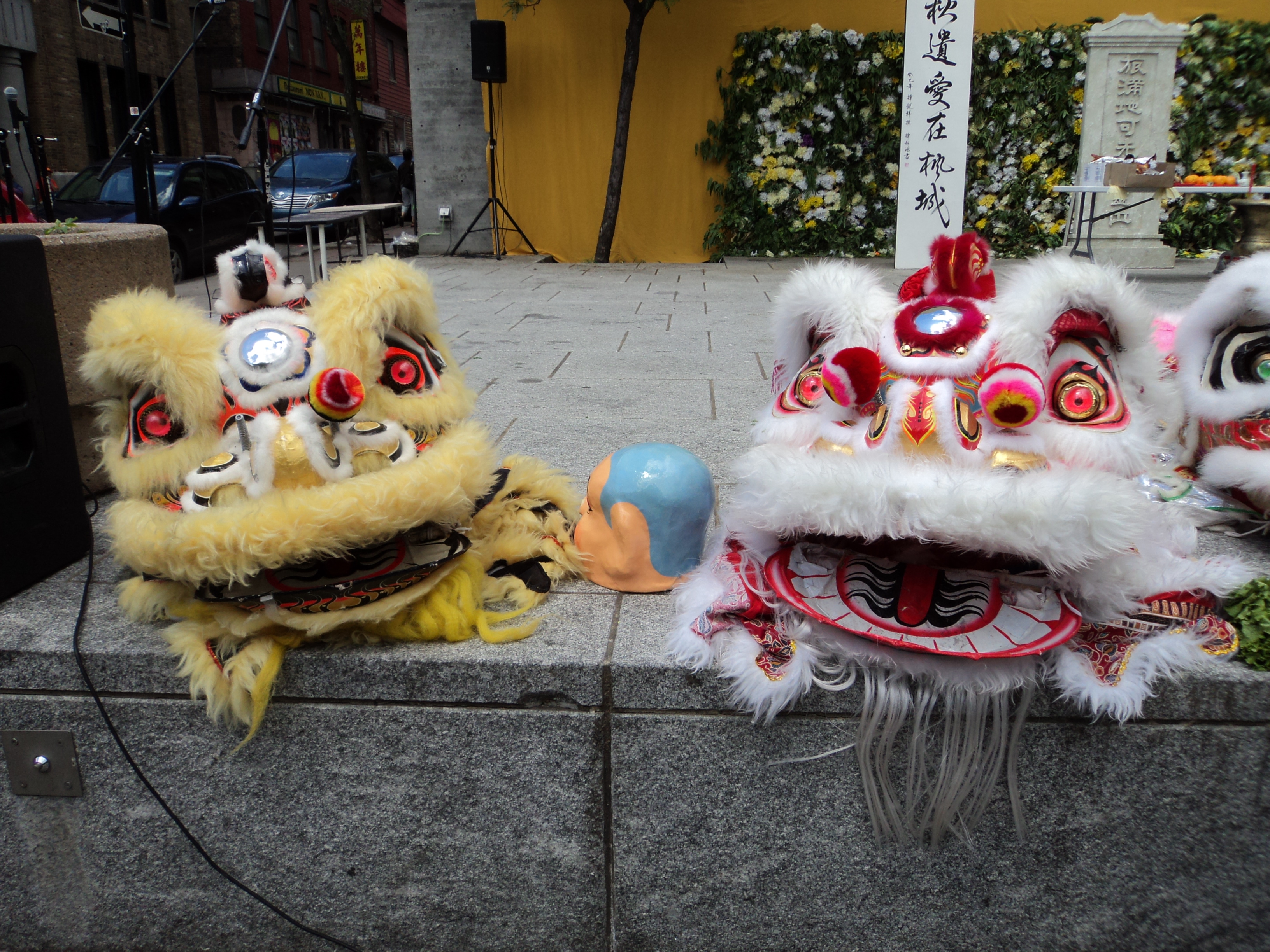
Lion heads

On Sunday, June 9th, I went to Chinatown to watch The Ancestral Ceremony. It’s an annual event held by the Montreal Chinese Association to honor our ancestors who came to Canada from China to build the Canadian Pacific Railway. After the railway was built, some of these men settled down in Montreal, creating what we now know as Chinatown.

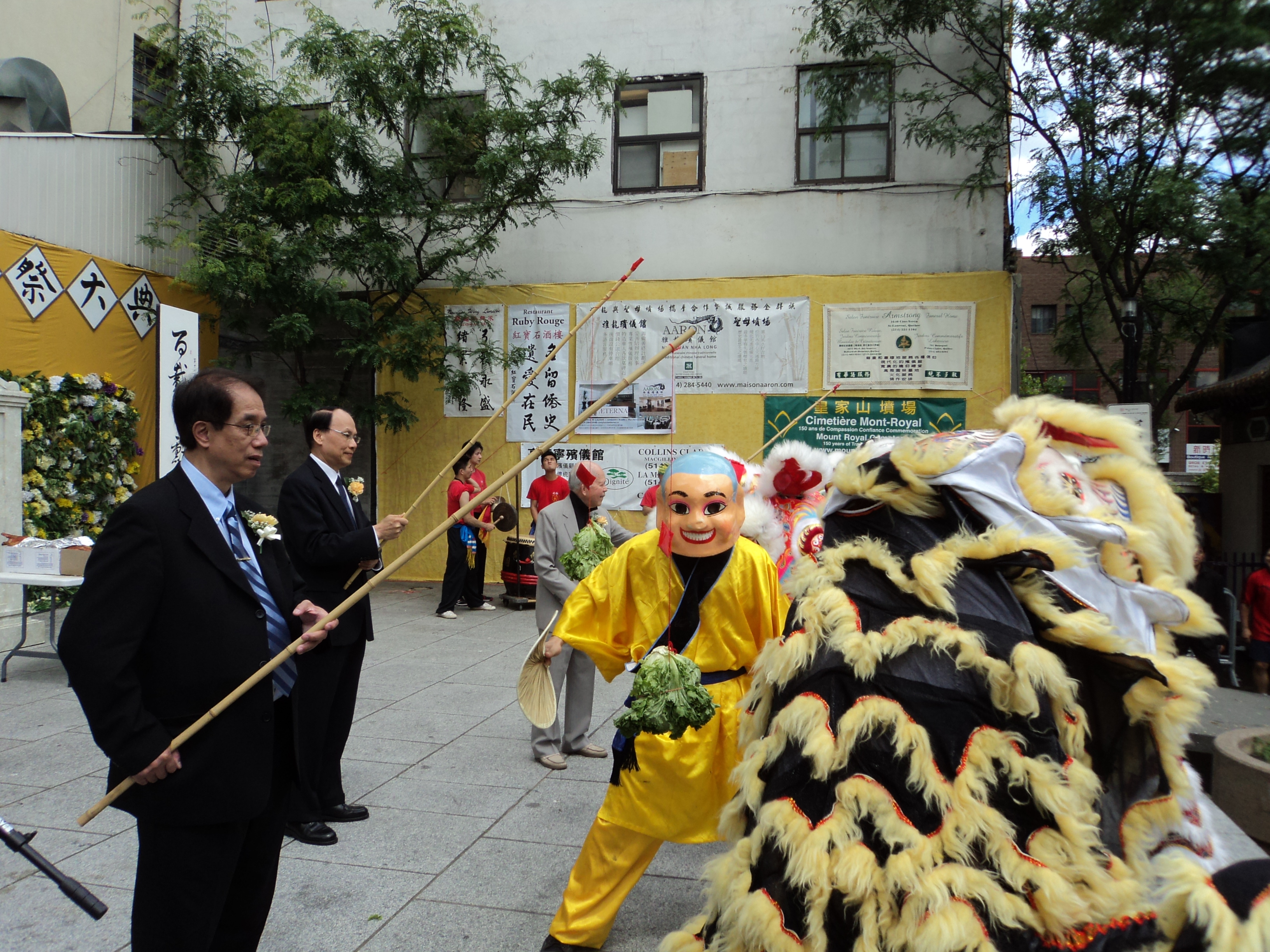
The hour long ceremony was held in Sun Yat Sen Park. It started with the Lion Dance to wake up the spirits of the ancestors. Dancers dressed in colorful, shimmering lion costumes danced to the beat of cymbals, a gong and a drum that was loud enough to…well,…wake up the dead. After the  ceremony was over, local talent comprising of Chinese musicians, dancers and singers of all ages entertained the crowd. I only took a few photos, but as they say, a picture is worth a thousand words.

SCFA2013 (4)

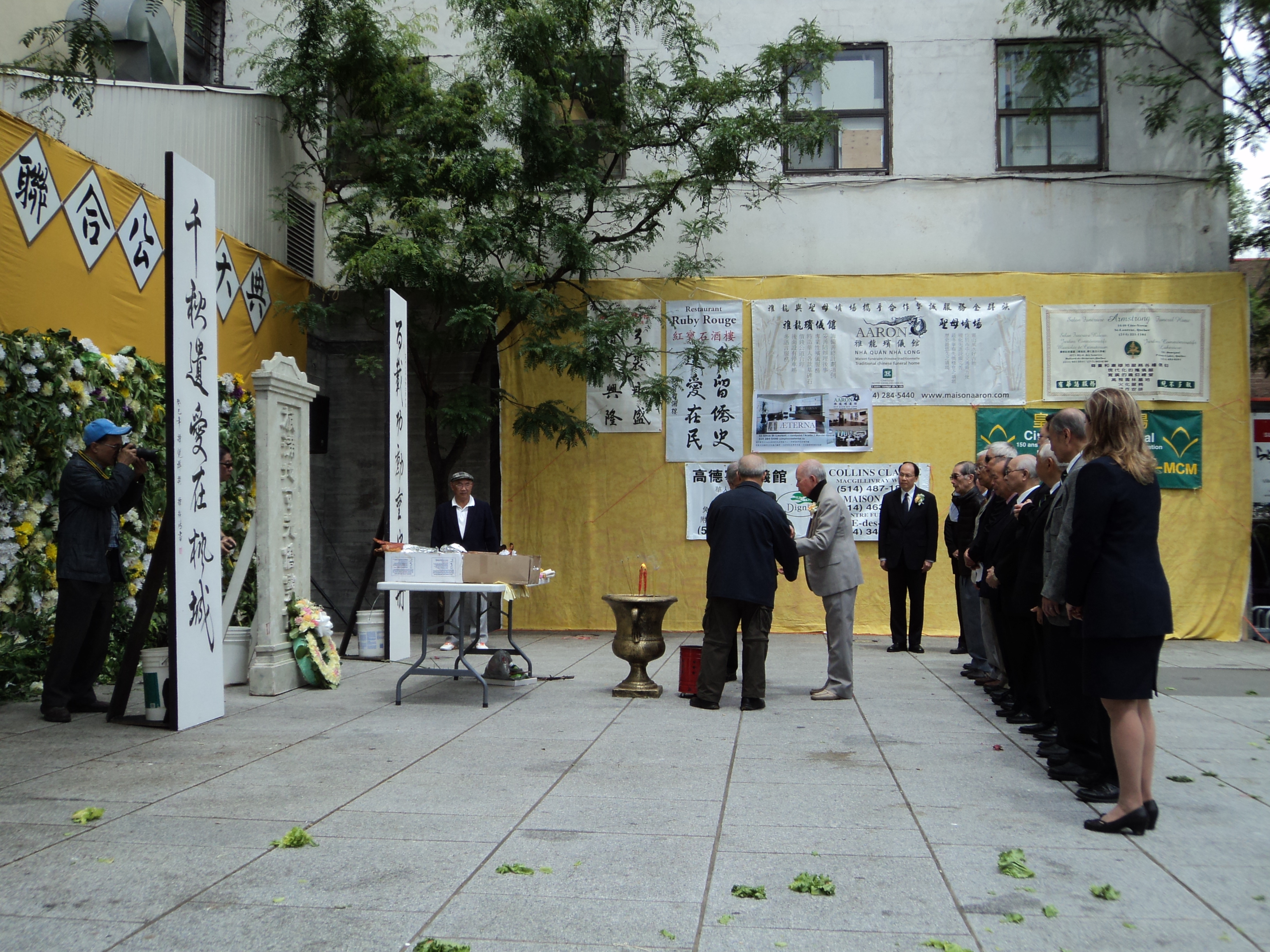
Offerings on the makeshift altar include a whole roasted pig. The urn is used to burn incense. Paper money is burned in a separate container.

SCFA2013 (11)

There is a feeding frenzy as the lions prepare to eat the red envelopes and lettuce dangling from the poles.

SCFA2013 (16)

A crowd gathers in Sun Yat Sen Park to watch the ceremony.

SCFA2013 (18)

Leaders of the Montreal Chinese Community stand before the altar as offerings are made to the ancestors.

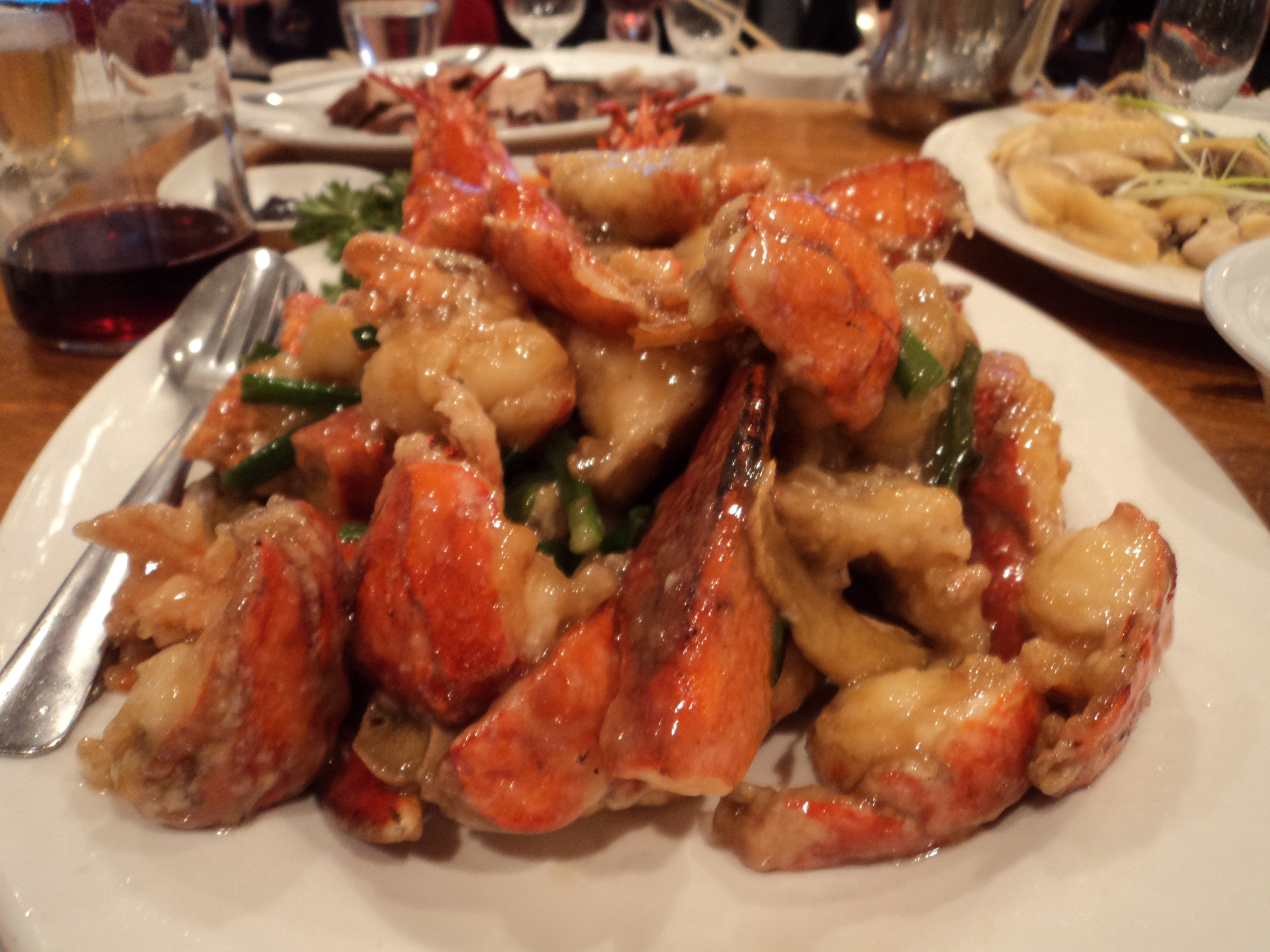
I was invited to attend the Association’s closing banquet at Kam Fung Restaurant that evening. It was a delicious ten course meal that included fish ball soup, deep fried sea food rolls, beef with chinese vegetables, fried rice and noodles. To tempt your curiosity and taste buds, below are photos of some of the other dishes. In all, it was a good day.

SCFA2013 (32)

Tofu and baby bok choy

SCFA2013 (31)

Ginger lobster

SCFA2013 (30)

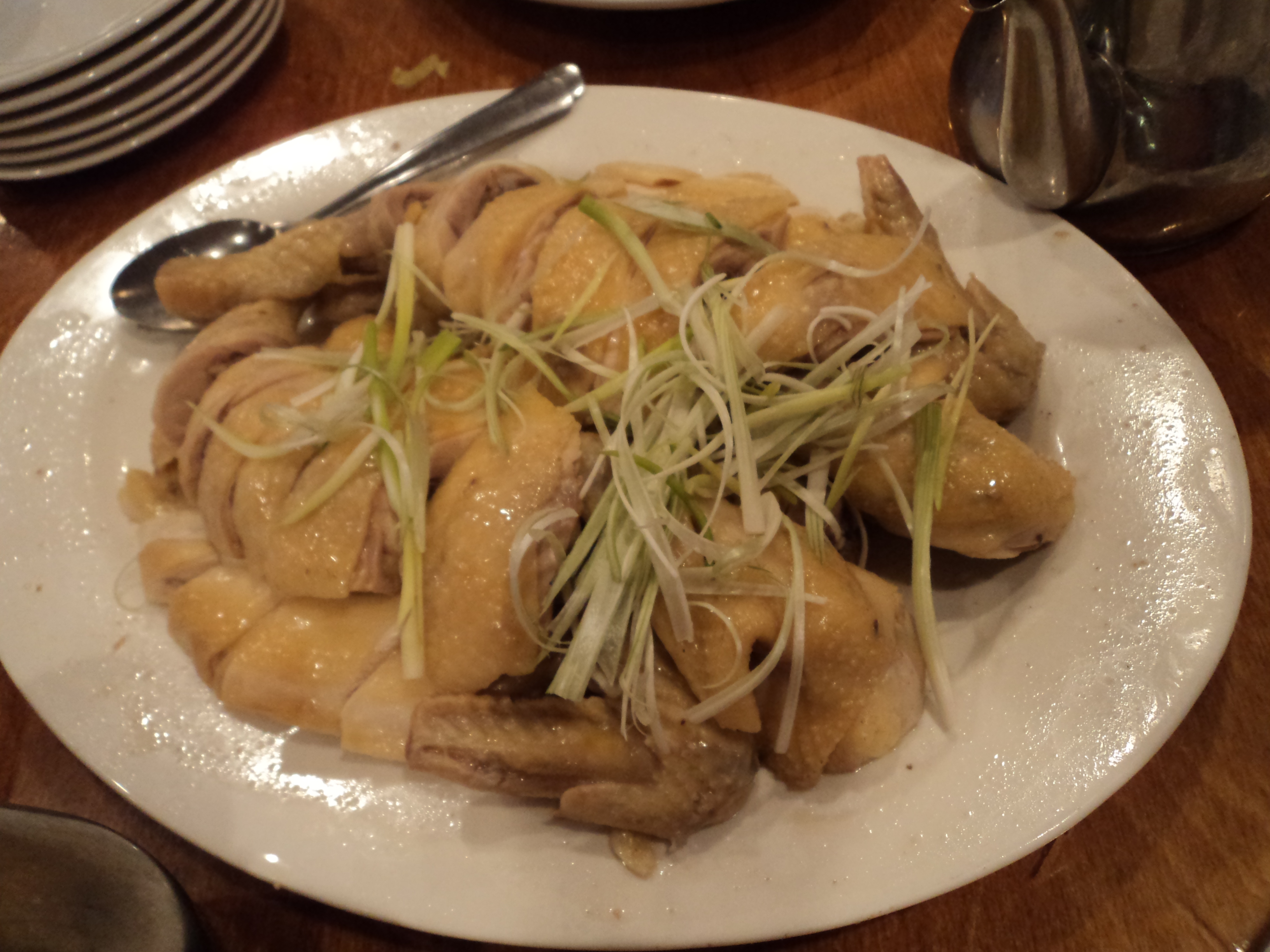
Steamed chicken, very tender and moist

SCFA2013 (29)

War Siu Guy, a delicious combination of chicken and shrimp. My favorite!

SCFA2013

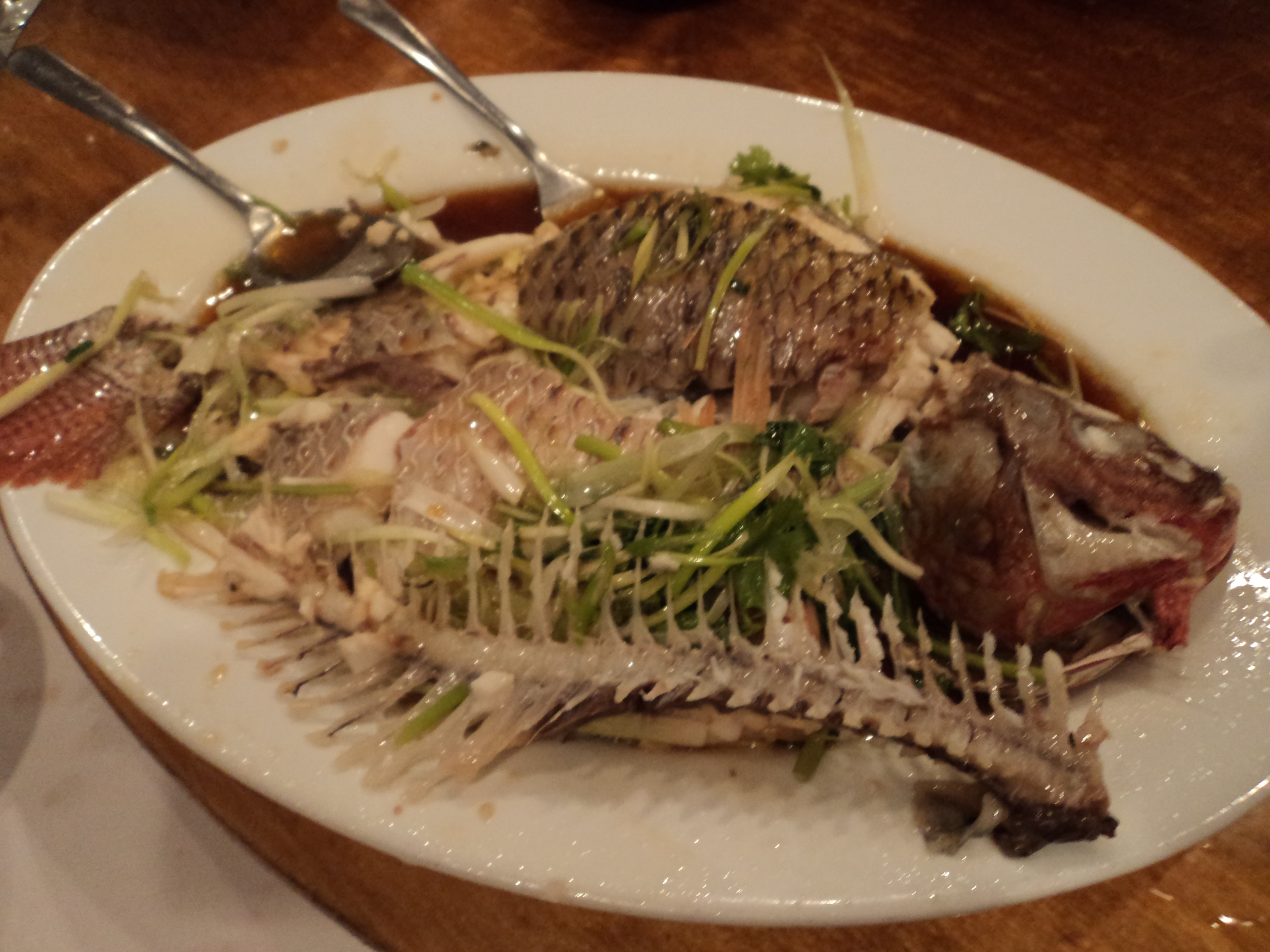
Steamed fish

How Karaoke Turned Me into a Blogger

Making the decision to write a blog is like singing karaoke. Once you open your mouth, there’s no going back.

I’ve been weighing whether or not to start a blog for months. What would I write about? How often do I have to write? Who’d even want to read it? So while I agonized over it, I did nothing.

Then, recently, I went out for a bridal stag party. The five of us, including the bride, were celebrating her last night out on the town as a single girl. The plan was supper, drinks, karaoke and a male strip club.

It sounded like a fun evening except for the karaoke part. I can’t hold a note unless it’s from my doctor. The extent of my singing career was the choir in elementary school. Since then, I lip sync the national anthem at sports games and enthusiastically whisper the words to “Happy Birthday” at parties.

So after a delicious supper, cocktails, Tiramisu and coffee, it was time to head to the karaoke club.  It was located in an office/shopping mall in the downtown area. I followed the bride down the dark, narrow stairwell to the basement level. A wall of tiny mirrored tiles reminiscent of the 1970s announced that we had arrived. Then we stepped into the reception area that was basically the inside of a disco ball.  After checking out the cost with the Asian hostess, we figured we’d only be an hour, and then leave for the strip club.

The room was furnished with a plump red L-shaped sofa, a huge monitor on one wall and a control panel that looked like a prop from the original Star Trek series. My friends eagerly lined up their choices on the control panel. Then, we solemnly promised each other that nothing would appear on Facebook.

My friends jumped right into it with a Chinese love song. Their voices rose fearlessly above the music blasting from the speakers. I told myself that it was okay to sit on the sidelines. I can’t speak, never mind sing in Chinese, but their enthusiasm was infectious. After watching them belt out a few songs, I decided to throw aside my inhibitions. If I can’t sing inside a soundproof room with my close friends, then where can I?

And, there’s only one way to sing karaoke: loud!

We told that guy to “Call Me, Maybe,” screamed “Baby, Baby, Baby, Ohh!” and danced Gangnam Style. We totally forgot about the strip club. We were having a blast.

There’s nothing like friends who’ll forgive you for murdering a song. While I still sing like a complaining cat, karaoke taught me not to hold back. Sitting on the sidelines means missing out on the fun. So I’m jumping into this blog with both feet and all fingers on the keyboard.

Lucky for you, I’m typing, not singing.