Pumpkin Inferno

Ghosts and Goblins in the Nighttime

Ghosts and goblins in the night are the subject of my entry for the photo challenge Nighttime.  Last October, I went to PUMPKIN INFERNO at Upper Canada Village where they create displays made out of fake pumpkins. Just to give you an idea of how these were made, below is a before and after picture.

If you go, be prepared to walk a lot, bring a jacket as it’s in an open field, and remember to charge your camera batteries.

Continue reading

Bagg Street Shul

Walking Tours with the Museum of Jewish Montreal

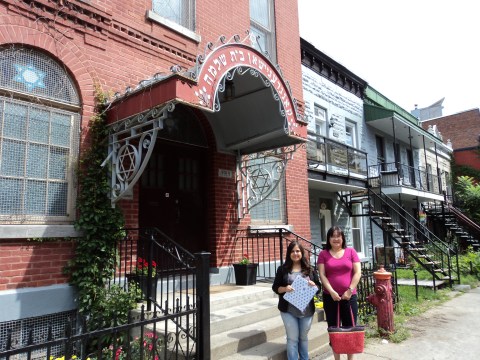
Doing research for a project can either be a chore or a pleasure. It was the latter for me recently. I’ve been researching Jewish history in Montreal when a friend mentioned that the Museum of Jewish Montreal gives walking tours. It sounded like a lot more fun than just reading about it, so I signed up for “Making Their Mark,” a tour of the Jewish community that existed in the Plateau area from the turn of the 20th century until the 1950s.

I met Laura, my tour guide, at the corner of St. Laurent and Milton. Since I was the only one who signed up for that day, it would be a private tour. We spent the next two hours viewing buildings that were formerly synagogues, schools and hospitals which Laura brought to life as she talked about the immigration of Eastern European Jews and how they established their community, culture and what was once Montreal’s thriving schmatta industry.

Continue reading

Canada Day Cake 2014

Canada’s 147th Birthday

My friends, Celia and Pauline, had volunteered to barbecue hamburgers at a Canada Day celebration in Montreal West. Being the good and loyal friend that I am, I decided to support their efforts by eating one. It was a hot, muggy day perfect for relaxing in the park listening to live music and taking advantage of the ice cream carts. Here are a few photos of the festivities. Happy Canada Day, everyone!

The Fitting Room by Cheryl Sim

Chinese Fever

Looking for some free things to do around Montreal? Head towards Chinatown and take a look at a couple of exhibits by local artists.

Cheryl Sim

Cheryl Sim

La Cabine d’Essayage (The Fitting Room) by Cheryl Sim is aptly located in a small corner of a shopping mall in Chinatown amid clothing and accessory boutiques.

Sim examines the cheongsam, which according to her, is a dress that has become an internationally recognized symbol of Chinese cultural identity. She asks Canadian-born Chinese women how they feel about the dress and if they have a desire to wear it. You get to listen to their answers through headphones and feel as if you’re a part of their conversation. Also part of the exhibit is a video-sculptural work that evokes the classic Chinese screen on which photos and videos showing the evolution of the cheongsam are displayed, and a transparent, plexi-glass fitting room which projects clips from Hollywood films onto the visitor’s body.

Continue reading

Does this St. Hubert commercial depict Chinese people in a negative way?

St Hubert Restaurant For the past few weeks, the St. Hubert restaurant chain has been running a commercial where the owner of a Chinese restaurant discovers St. Hubert has a $7.95 meal deal. Both of the actors are Chinese and speak in Cantonese with either English or French subtitles. The complaint is that the commercial is demeaning and offensive. It has drawn criticism and comments on its Facebook and Twitter accounts, and sparked a national dialogue on the stereotyping of Chinese-Canadians.

You can watch it here in English followed by the French version.

Do I think the St. Hubert commercial is stereotyping Chinese people? Yes, but not in a negative way.  Is it demeaning? I don’t think so.

Television has not done a good job of depicting Chinese people. I watched the TV series Bonanza when I was growing up and found the character of the Chinese cook, Hopsing, kind of…confusing. My father and none of the Chinese men I knew had a long braid or behaved in a subservient way. Then there was the practice of casting Caucasian actors in Chinese roles, such as Charlie Chan who was played by three Caucasian actors and the TV series Kung Fu where David Carradine was chosen over Bruce Lee to play the lead role.  There are a handful of Asians on prime time shows now, but basically unless there is a scene that takes place in Chinatown, it’s rare to see a Chinese person on TV.

Continue reading

Celebrate Asian Heritage Month

Asian Heritage Month 2014


If you have always wanted to try dim sum but never got around to it, then here’s a good reason to go: May is designated as Asian Heritage Month. The Canadian Government’s web site (where you can download the poster above) says “Asian Heritage Month is an ideal occasion for all to celebrate the beauty and wisdom of various Asian cultures.”  Of course, you can celebrate anytime of the year, but what better excuse to order Chinese take-out and indulge in a marathon of Bruce Lee or Ang Lee films?

Need some more ideas? Here are a few from my shelf of Canadian books and film:

Books

I’m currently reading A Cowherd in Paradise – From China to Canada by May Q. Wong and am loving it. It’s the story of Wong’s parents who were forced to live apart for 25 years because of Canada’s exclusionary immigration laws. It is a well-written account with family photos and it brings to life the price the Chinese paid when Canada enacted the Chinese Immigration Act. I met Wong when she came to Montreal to do a reading of her book. You can read about it here. 

The Measure of a Man: The Story of a Father, a Son and a Suit by J.J. Lee was a finalist for the Governor General’s literary award for non-fiction in 2012. This book deserved all the accolades it received. This memoir about a son who decides to become an apprentice to one of the last great tailors in Vancouver’s Chinatown in order to alter his father’s suit learns invaluable lessons about life instead.

The Jade Peony by Wayson Choy is, in my opinion, a classic. It’s the story of the children of an immigrant family living and growing up in Vancouver’s Chinatown in the 1930s and 1940s. Continue reading

Digging for Chinese Treasure…in a Museum

Karen Tam

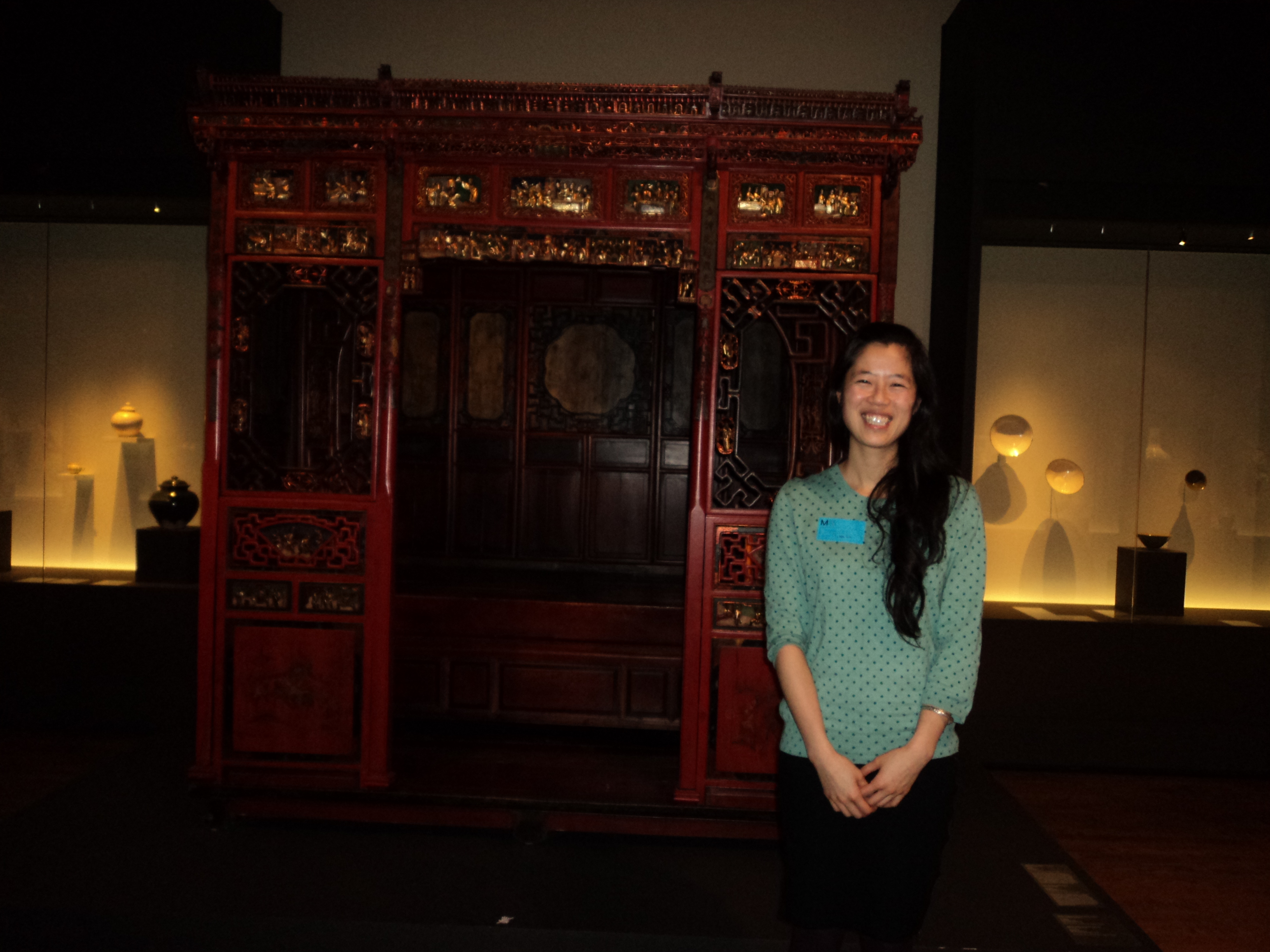
Karen Tam in front of Qing dynasty Alcove Bed at the Montreal Museum of Fine Arts

When my friend Karen Tam, told me earlier this year that she was the artist-in-residence at the Montreal Museum of Fine Arts, I asked her two questions:

1) Do the statues come to life like in the movie A Night at the Museum?
2) What was she doing there?

So maybe my imagination is fueled by movies including Indiana Jones and more recently, Monument Men, and maybe I was disappointed that the answer to my first question was “no,” but I found Karen’s project to be very intriguing.

I met her again on the last day of her residency, this time at the museum, to find out exactly what she was working on. She had spent six weeks exploring their archives and learning about the history of the museum’s collection of Chinese art and artefacts. It was late Friday morning, and we sat on a vinyl bench on the third floor where only a handful of people were perusing the display cases.

Many of the objects she examined came from antique dealers in New York, Boston and London, two of who obtained valuable artefacts because of major historical events. Goods belonging to Japanese-Americans who were interned during the Second World War wound up in the hands of Yamanaka Sadajirô and his company Yamanaka & Co which dealt in government confiscated goods. The other one was C.T. Loo.  Treasures that once belonged to the Chinese Imperial Family fell into his hands as they sold what they could in order to flee China before the fall of the Last Emperor and the Japanese invasion. Accused of being a thief and looter of China’s national treasures, Loo defended himself by saying he was actually saving the art by selling them to collectors.

It seems that the museum also played a small part in history. In the 1940s, the museum held three exhibits by Chinese artists of which one was to raise money for China’s Nationalist Party and another for China’s Communist Party. However, all three exhibits were held when Canada’s Chinese Exclusion Act (which banned Chinese immigrants from entering the country from 1923-1947 )was still in force. Canadian society, while appreciating the art and culture of the Far East, did not hold the same appreciation for the people who created it.

The museum’s Chinese collection holds many stories, but as Karen’s residency ends her interest does not. She is holding talks with the museum about the possibility of holding an exhibit based on her discoveries. In the meantime, her next installation will be at the Mendel Art Gallery in Saskatoon as part of the exhibition “Convoluted Beauty: In the Company of Emily Carr,” at the end of June. Her subject will be Lee Nam, a Chinese immigrant to British Columbia, who was a painter and a friend of Emily Carr. In collaboration with Montreal-based painter, Lui Luk Chun, a senior artist in his seventies, she will re-imagine what Lee Nam’s studio looked like in the 1930s.

You can read more about her experience as artist-in-residence at the Montreal Museum of Fine Arts on her blog Pumpkin Sauce. Check out her portfolio at http://www.karentam.ca.

Click on the link to learn about the artist’s residency at the Montreal Museum of Fine Arts.

The Potato Wars: How Chinese Farmers Fought for the Right to Sell Potatoes

The Potato Wars is a true story about how in 1935, a group of Chinese potato farmers fought The BC Coast Vegetable Marketing Board for the right to sell potatoes. The Board had implemented a system of quotas and fixed prices that prevented the Chinese from selling their produce in Vancouver. It’s a piece of Chinese-Canadian history that graphic artist, Joanne Hui, examines in a unique way and in the process, makes learning history fun.

Check out Joanne’s blog here  or take a look at her work and profile at En Masse.

20140126-191702.jpg

Lion Heads waiting to welcome 2014

Enter the Lions – Welcoming the New Year Chinese Style

The pounding beat of a drum, the clash of cymbals and the sound of firecrackers rang through Montreal’s Chinatown Sunday afternoon to scare away evil demons. The lions had arrived to celebrate the New Year. The lions are members of The Montreal Chinese Lions Dance Club, a martial arts and lions dance club. Dressed in colourful, shimmering costumes, they visit stores, restaurants and tong associations in Chinatown to wish them luck and prosperity in the New Year.

Thank goodness the deep, freezing cold temperatures broke this weekend. It was a balmy -1 Celsius. The snow was turning to slush. A small cloud of smoke billowed as firecrackers exploded in Sun Yat-Sen Square. The lions bowed and pranced in front of guests of honour, each of whom dangled a head of lettuce and a red envelope from a pole.  According to tradition, the lion eats the lettuce and the envelope. Then, it tosses the pieces of lettuce in the air to wish the person and the establishment prosperity in the coming year.

The crowd followed the lions up Clark Street to their first stop. Someone on the second floor dangled a head of lettuce and a red envelope from a pole high over the sidewalk. The lions leaped and danced and successfully grabbed both items.

Le Cristal was packed with customers having dim sum when the lions made their entrance into the restaurant located on the sixth floor. Cameras and cell phones snapped photos as the lions wound their way around the tables and headed towards the far end. The owners hung the lettuce and red envelope from the ceiling which was more of a challenge since it was so high. Customers cheered as the lions made several attempts and then burst into applause when they succeeded.

For the next three hours, the lions made their way into shopping centers and stores. They stopped at doorways marked by a head of lettuce and a red envelope hanging from the top, or where someone waited with a pole. The crowd grew as the small parade made its way along La Gauchetière Street, chasing away evil spirits to ensure the community a happy and prosperous new year.