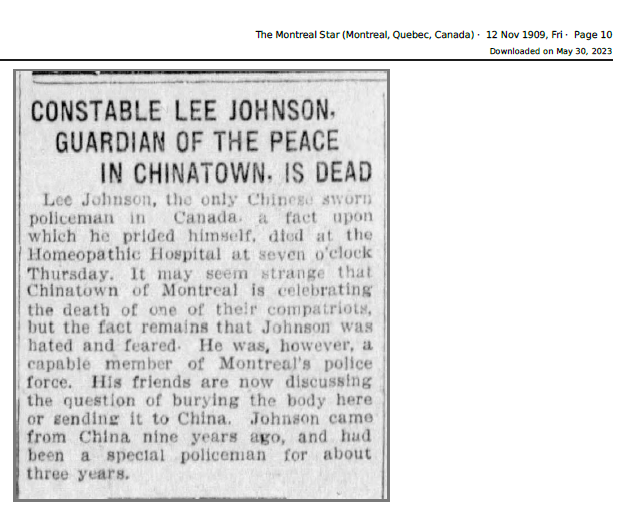
The first Chinese man to become a policeman in Canada was Constable Lee Johnson. He was sworn in on December 28, 1906.
Lee who had been a British subject for seven years, described himself as a commercial traveler. He was assigned to pay particular attention to Montreal’s Chinatown as he was familiar with all the Chinese gamblers and the men who ran the opium dens. A British subject for seven years, he spoke Chinese, French and English. He carried a revolver, a baton up his sleeve and a badge to display his authority. His exploits were reported in The Gazette and The Montreal Star.
Constable Lee Johnson died of typhoid fever on November 11, 1909.
This fact was discovered by Robert Wilkins, who helped me with research during the production of my documentary. If you’re interested in learning about life in Montreal during the Edwardian era, take a look at Robert Wilkin’s books: Grandad’s Montreal 1901, Montreal 1909, and Montreal Recorder’s Court, 1906. You can find them at Paragraph Books and Argo Bookshop.
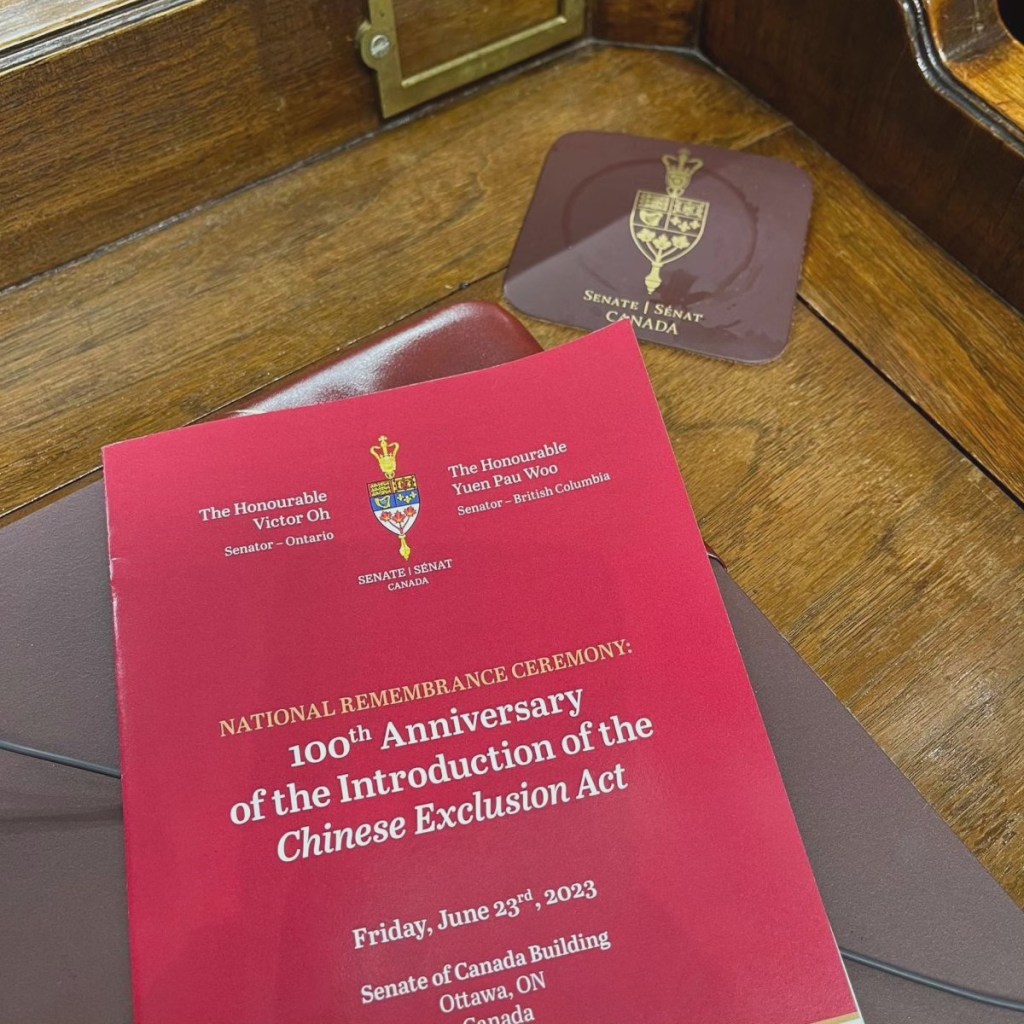
It was going to be a historical moment and the place where it was going to happen was significant. The place is a former train station that was a part of the railway network that Chinese labourers built across Canada. Currently the temporary home of the Senate of Canada, it was an appropriate venue to hold the National Remembrance Ceremony for the 100th Anniversary of the Introduction of the Chinese Exclusion Act.
The Act was officially called the Chinese Immigration Act and was passed into law on July 1st, 1923. It prohibited the Chinese from entering Canada, with a few exceptions. The date coincided with Dominion Day, now known as Canada Day. For decades, the Chinese called it Humiliation Day. When I was a kid, I never understood why my father refused to celebrate Canada’s birthday. I was an adult when I finally discovered this was the reason why. That’s why I wanted to see this ceremony; to see how far Canada has come since it enacted that racist law. The ceremony was held in the Senate on June 23, 2023, a week before the actual July 1st date.
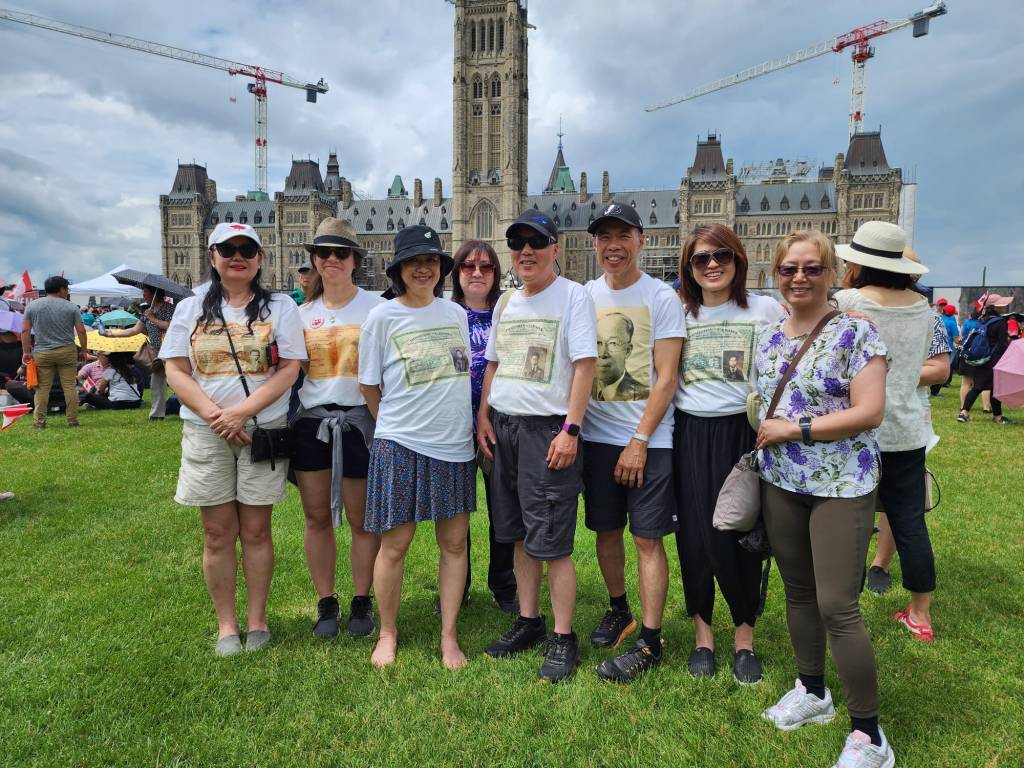
My family was directly affected by the Act that was passed by Prime Minister William Lyon Mackenzie King’s government in 1923. The Exclusion Act forced the Chinese to register with the government or risk fines or deportation or imprisonment. My father was 13 years old when he paid $500 to enter Canada in 1921, arriving just two years before the Act was passed. It separated him from his family in China for 24 years until the law was challenged and repealed in 1947. Since I didn’t get an invitation to the ceremony, I did the next best thing. I drove to Ottawa with other members of the JIA Foundation, a non-profit organization dedicated to ensuring Montreal’s Chinatown history and stories are celebrated and not forgotten. There, I joined the Ottawa Chinese community to watch a live stream of the event at the Ottawa Convention Centre.
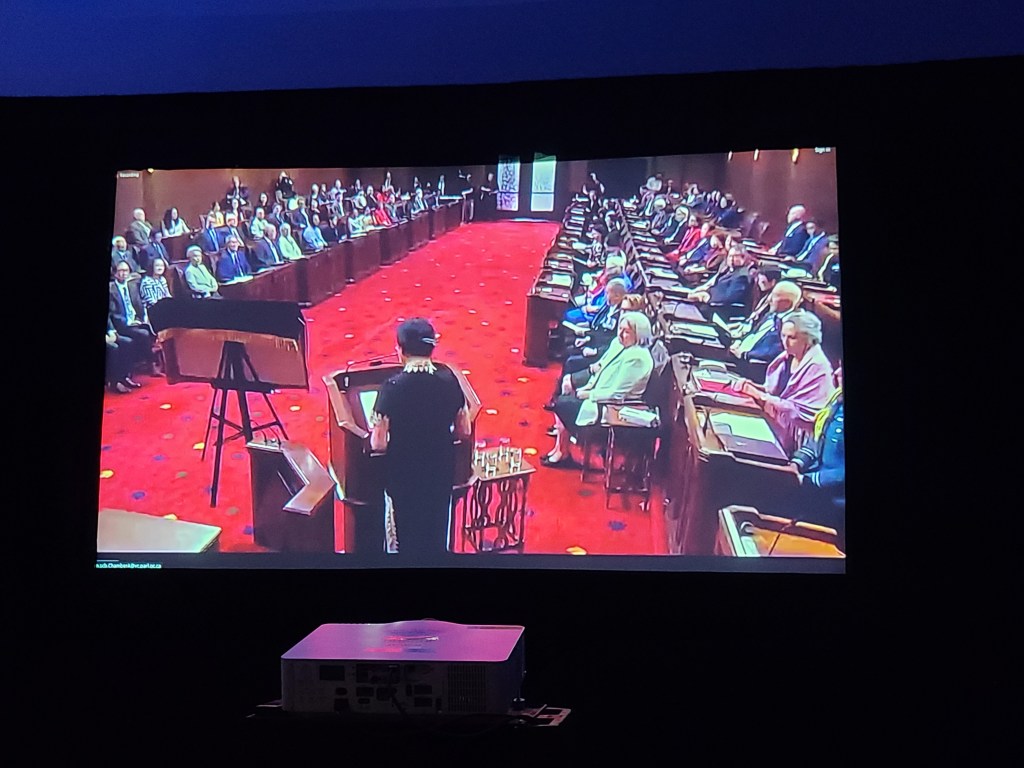
I wasn’t sure what to expect as I entered the ballroom in the Convention Centre that was set up to accommodate a few hundred people, but I enjoyed the three hour ceremony. After opening remarks and an Indigenous Blessing, a commemorative plaque was unveiled. It will be installed at the Chinese-Canadian Museum when it opens in Vancouver on June 30th.
Of course, there were speeches, but they included touching personal stories from Chinese Senators and Ministers about how the Exclusion Act affected their own families. And there was entertainment. Right on the floor of the Senate where the Act became law, were performances that reminded everyone of the damage and suffering it had caused. The Goh Ballet performed a dance called “Pathways to the Future”. A song that was written by an unknown composer 100 years ago in protest of the Act, entitled “Never forget July 1st” was performed by the National Remembrance Ceremony Choir, conducted by Chin Ki Yeung. The music was composed by Ashley Au. But it was Christopher Tse’s powerful spoken word performance that brought everyone in the senate to their feet. Later on, when he arrived at the Convention Centre to meet the community, I asked him what it meant for him to be able to recite his poem in the Senate.
“It’s an honour for sure. To have that space in this building, in this instance that represents a government that was responsible directly for putting this legislation in place in the first place,” said Tse. “So it feels strangely symbolic, a bit of a full circle.”
Others I spoke to felt the same way. Anto Chan, host of the live-streaming event at the Ottawa Convention Centre said that seeing the past 100 years acknowledged was powerful. Melissa Tam, whose family was also affected by the Act, felt the ceremony was important as people are still dealing with issues.
So, this Saturday, July 1st, I will celebrate Canada Day as usual. I will also wonder how my father, if he were still alive, would have felt about the Remembrance Ceremony. Thanks to him and all the ancestors who fought for the right to stay in this country, their children, grandchildren and new immigrants enjoy all the benefits of being a Canadian.
However, we still find ourselves fighting anti-Chinese sentiments in spite of all the financial, economical, and artistic contributions the Chinese have made to this country. I think part of the fight is to tell people who we are and what we bring to the table. Sharing our culture, knowledge and friendship is ongoing, but we are more than just a menu at a Chinese-Canadian restaurant. We are a part of the beating heart that drives this country forward.
These are four little words that big dreams are made of and I actually got to live it in real life.
Like many film festivals the world over, the Yorkton Film Festival is virtual this year due to the pandemic. Kicking off the festival which is being held from May 27th to 30th was the award ceremony which was streamed live on opening night. My documentary Meet and Eat at Lee’s Garden was nominated in three categories: Research, Multicultural over 30 minutes, and Documentary History and Biography.
This documentary is my first. Six years ago I had a story idea and I just knew that it had to be a documentary even though I had no experience making one. So just how did it get to be nominated for three of Yorkton Film Festival’s Golden Sheaf Awards?
I think my training and experience as an author had a lot to do with it. For the past two decades, I have been writing and publishing fiction and non-fiction. I’ve attended workshops and conferences on almost every aspect of the business of writing: how to craft stories, do research, how to pitch a story, how to write a synopsis, copyright and more. With a degree in journalism, I already knew how to interview people. Most importantly, I love documentaries. It’s been one of my favorite genres since I was a teenager. And just like the recommendation that anyone who wants to be a writer should read as much as they can, anyone who wants to make documentaries should watch as many as they can.
I figured that the skills I learned as an author would be transferable to film. After all, they are both about storytelling. So I approached filmmaking the same way I write. I found the heart of the story, and then set about to create a beginning, middle and an end, but not necessarily in that order.
It was a ton of work. Maybe even two tons. There were a lot of ups and downs, moaning about who would even watch it (I do the same with my writing “Who would want to read/publish it!?”), evenings spent researching digital libraries for photographs and video footage, checking facts, finding people to interview, transcribing interviews, agonizing over which scenes to keep or cut and figuring out how to change scenes and introduce new characters. I was producer, director and writer and I loved wearing all those hats.
It premiered on the CBC on November 14, 2020, and just like I do at a book launch, I nervously hoped people would like my baby. They did.
So that is how I found myself sitting at my dining table watching the Yorkton Film Festival award ceremony on my laptop anxiously waiting to hear whether my film would win in any of its categories.
It wasn’t a Zoom conference so winners would not give an acceptance speech. The presenters did a nice job of introducing and announcing the awards. To me, it felt like the Academy Awards. Each time they announced one of my categories, I held my breath. The poster flashed across the screen and I was tense with excitement. They announced the other nominees.
And then . . . the winner was someone else.
Of course I was disappointed. The end of that dream is winning the award, but it still feels really good just to have been nominated. This is so much more than I expected for my first documentary.
My congratulations to Captive produced by Antica Productions for winning the award for Research, The Articsproduced by Midnight Light Media for winning Multicultural 30 Minutes and Over, and to Mr. Emancipation: The Walter Perry Story produced by The Walter Perry Freedom Foundation for winning Documentary History and Biography. I’m looking forward to watching these films.
It ain’t over folks. Meet and Eat at Lee’s Garden was selected by the Austin Asian American Film Festival which runs from June 4-20, 2021. It was rejected by a handful of other film festivals but I’m expecting a response from 17 others throughout the year.
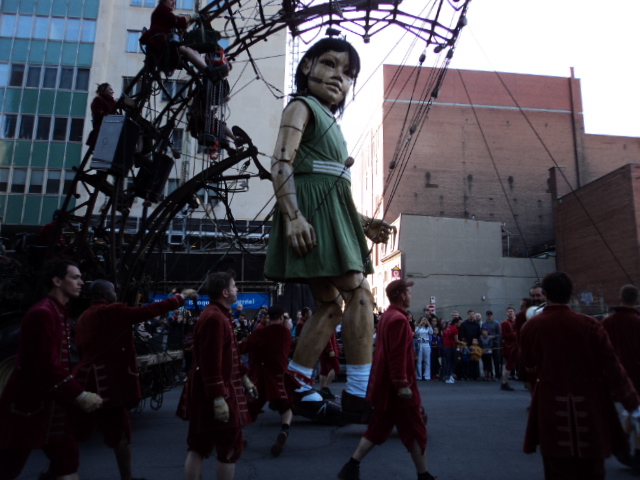
There are some huge celebrities here to celebrate Montreal’s 375th birthday, and I really mean huge.
The Giants are in town for the weekend. Not the football team. The Giants of the Royal De Luxe company are marionettes from France. There are three of them: The Sea Diver which is the largest, a Little Girl, which is the diver’s niece, and her dog. This is their first appearance in Canada.
It takes a lot of people to manipulate them and watching them work is as fascinating as the marionettes themselves. Continue reading →
I dropped by Chinatown this afternoon where the celebrations for the New Year were taking place. The Montreal Chinese Lion Dance Club was performing the ritual dance in front of various stores in Chinatown to wish them luck and good fortune for the new year. Here’s a short clip.
I wish you all good fortune for the Year of the Rooster!
The weather on Sunday seemed more appropriate for October than June, but it didn’t stop the Chinese Association of Montreal from holding its annual Ceremony of the Ancestors in Chinatown yesterday.
In the photos below, fake money is burned as an offering to the ancestors just outside the offices of one family association. Continue reading →
I’ve always wanted to see the inside of a TV news studio and got the chance yesterday when I was invited to appear on CBC Montreal’s six o’clock news program to talk about the story I wrote for Real Talk on Race. That’s me with Debra Arbec, the news anchor, in the photo above.
So now you get to see what my Cover Girl experience was all about. The CBC officially launched Real Talk on Race today. For the next two weeks, CBC Montreal’s radio, television and social media platforms will be discussing and encouraging people to talk about race and racial identity. Ten Montrealers, including me, contributed personal stories which you can read on their web site. My story will roll out on Wednesday, but you can have a sneak peek here.
Listen to CBC radio’s Daybreak and Radio Noon. You can join the conversation by texting or calling into the show. You can also like them on Facebook at https://www.facebook.com/CBCMontreal/ or follow them on Twitter and Instagram: @CBCMontreal.
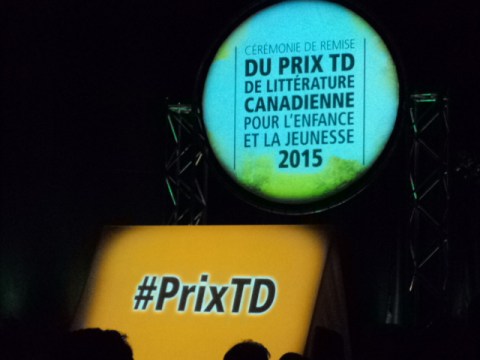
I took the night off from NaNoWriMo last night to go to the annual TD awards for Canadian Children’s Literature published in French. Five books were up for the $30,000 top prize. The event at the Montreal Museum of Fine Arts was an opportunity to mingle and meet writers and publishers in the French community. It’s so inspiring to see writers and illustrators being feted and recognized for their work.
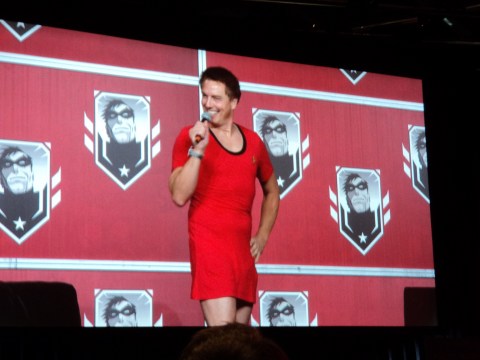
Yes folks, that is a picture of John Barrowman in Lieutenant Uhura’s dress and black size 13 pumps. Barrowman (Torchwood, Doctor Who and Arrow) was a Guest of Honour at this year’s Montreal Comiccon. He was wildly improper and funny, especially when telling stories of outrageous pranks he played on set. The audience loved him.









 Day's Lee