Commemoration of the 100th Anniversary of the Chinese Exclusion Act

It was going to be a historical moment and the place where it was going to happen was significant. The place is a former train station that was a part of the railway network that Chinese labourers built across Canada. Currently the temporary home of the Senate of Canada, it was an appropriate venue to hold the National Remembrance Ceremony for the 100th Anniversary of the Introduction of the Chinese Exclusion Act.

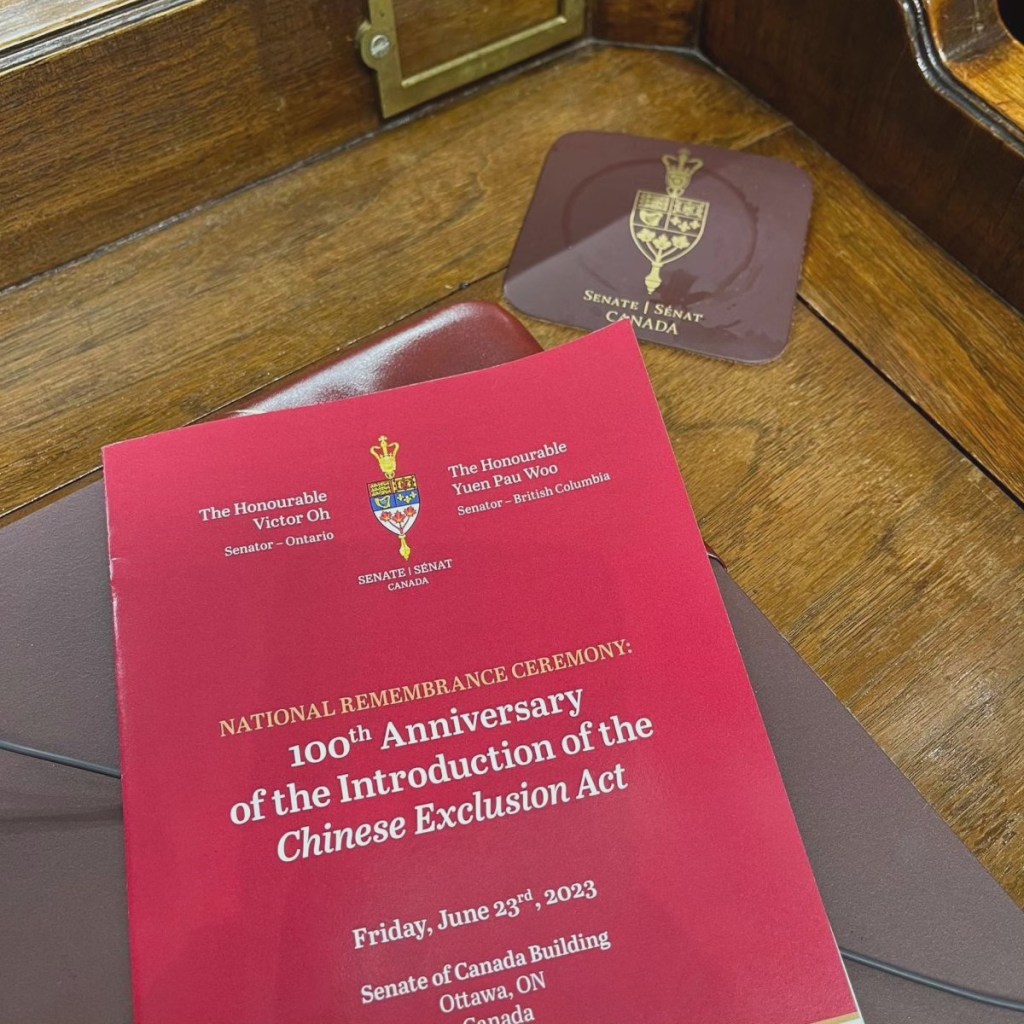
The Act was officially called the Chinese Immigration Act and was passed into law on July 1st, 1923. It prohibited the Chinese from entering Canada, with a few exceptions. The date coincided with Dominion Day, now known as Canada Day. For decades, the Chinese called it Humiliation Day. When I was a kid, I never understood why my father refused to celebrate Canada’s birthday. I was an adult when I finally discovered this was the reason why. That’s why I wanted to see this ceremony; to see how far Canada has come since it enacted that racist law. The ceremony was held in the Senate on June 23, 2023, a week before the actual July 1st date.

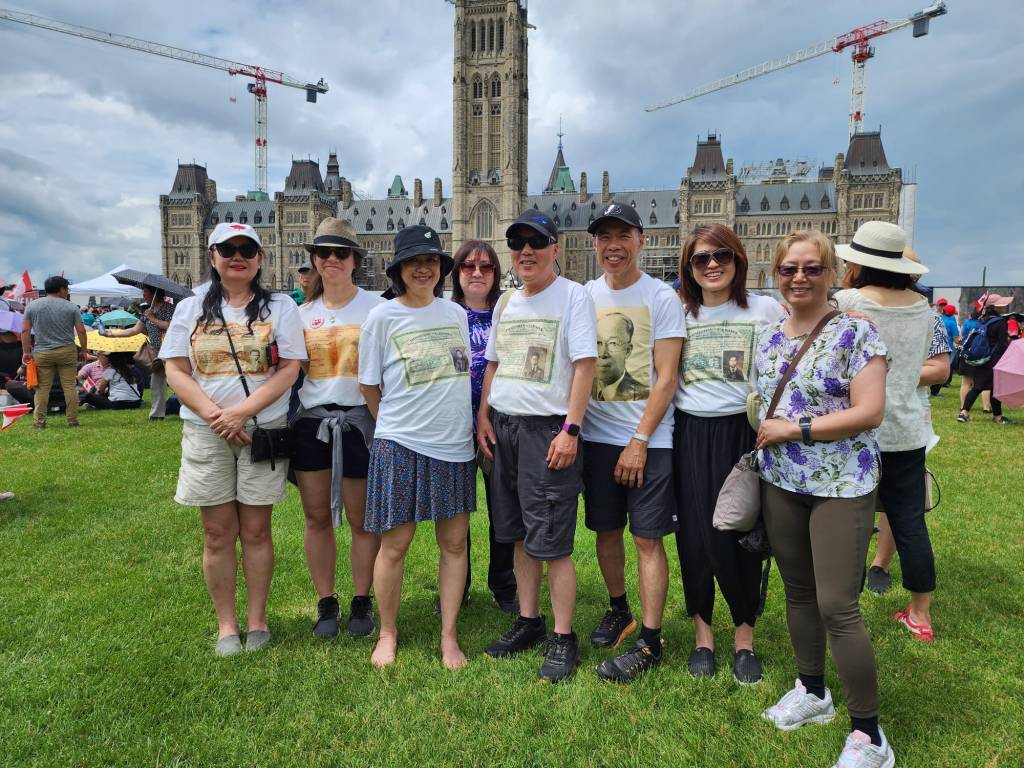
My family was directly affected by the Act that was passed by Prime Minister William Lyon Mackenzie King’s government in 1923. The Exclusion Act forced the Chinese to register with the government or risk fines or deportation or imprisonment. My father was 13 years old when he paid $500 to enter Canada in 1921, arriving just two years before the Act was passed. It separated him from his family in China for 24 years until the law was challenged and repealed in 1947. Since I didn’t get an invitation to the ceremony, I did the next best thing. I drove to Ottawa with other members of the JIA Foundation, a non-profit organization dedicated to ensuring Montreal’s Chinatown history and stories are celebrated and not forgotten. There, I joined the Ottawa Chinese community to watch a live stream of the event at the Ottawa Convention Centre.   

I wasn’t sure what to expect as I entered the ballroom in the Convention Centre that was set up to accommodate a few hundred people, but I enjoyed the three hour ceremony. After opening remarks and an Indigenous Blessing, a commemorative plaque was unveiled. It will be installed at the Chinese-Canadian Museum when it opens in Vancouver on June 30th.  
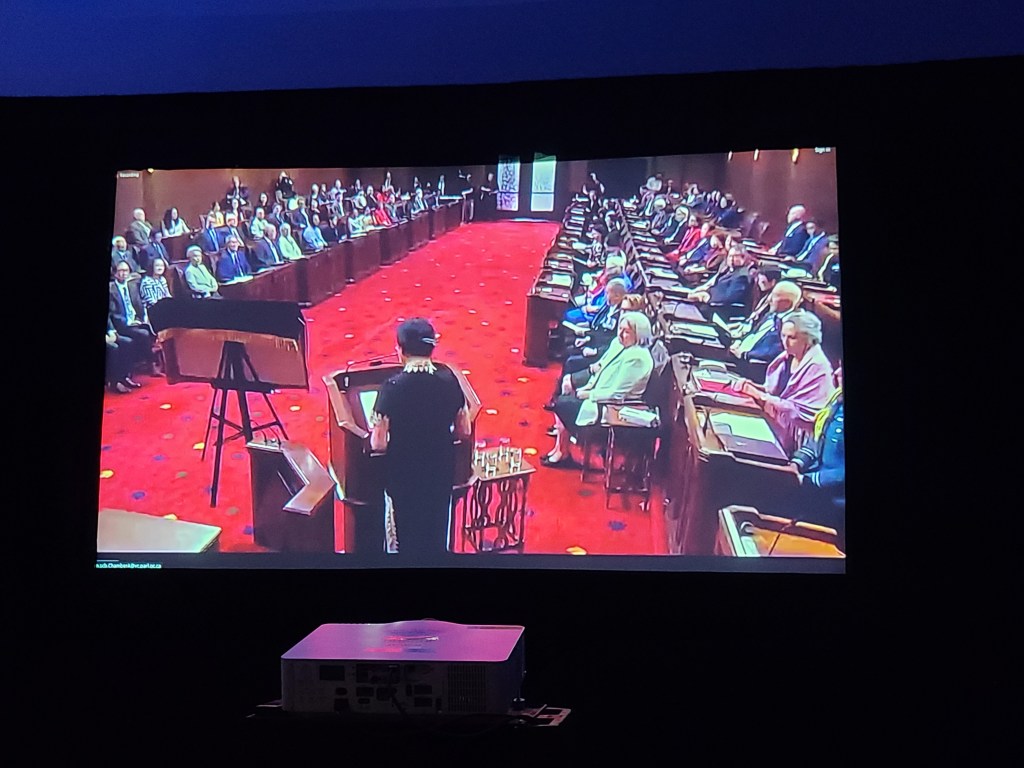
Of course, there were speeches, but they included touching personal stories from Chinese Senators and Ministers about how the Exclusion Act affected their own families.  And there was entertainment. Right on the floor of the Senate where the Act became law, were performances that reminded everyone of the damage and suffering it had caused. The Goh Ballet performed a dance called “Pathways to the Future”. A song that was written by an unknown composer 100 years ago in protest of the Act, entitled “Never forget July 1st” was performed by the National Remembrance Ceremony Choir, conducted by Chin Ki Yeung. The music was composed by Ashley Au. But it was Christopher Tse’s powerful spoken word performance that brought everyone in the senate to their feet.  Later on, when he arrived at the Convention Centre to meet the community, I asked him what it meant for him to be able to recite his poem in the Senate.

“It’s an honour for sure. To have that space in this building, in this instance that represents a government that was responsible directly for putting this legislation in place in the first place,” said Tse. “So it feels strangely symbolic, a bit of a full circle.”

Others I spoke to felt the same way. Anto Chan, host of the live-streaming event at the Ottawa Convention Centre said that seeing the past 100 years acknowledged was powerful. Melissa Tam, whose family was also affected by the Act, felt the ceremony was important as people are still dealing with issues.

So, this Saturday, July 1st, I will celebrate Canada Day as usual. I will also wonder how my father, if he were still alive, would have felt about the Remembrance Ceremony. Thanks to him and all the ancestors who fought for the right to stay in this country, their children, grandchildren and new immigrants enjoy all the benefits of being a Canadian.

However, we still find ourselves fighting anti-Chinese sentiments in spite of all the financial, economical, and artistic contributions the Chinese have made to this country. I think part of the fight is to tell people who we are and what we bring to the table. Sharing our culture, knowledge and friendship is ongoing, but we are more than just a menu at a Chinese-Canadian restaurant. We are a part of the beating heart that drives this country forward.

We are Canadian.
The Ancestral Ceremony

The weather on Sunday seemed more appropriate for October than June, but it didn’t stop the Chinese Association of Montreal from holding its annual Ceremony of the Ancestors in Chinatown yesterday.

In the photos below, fake money is burned as an offering to the ancestors just outside the offices of one family association. Continue reading

How to Tell if You Were Raised in a Chinese-American (or Canadian) Family

Photo from iStock

Photo from iStock

Read this hilarious post by LiAnne Yu and see how many of these signs you can identify with. I can identify with every one except #7 and 10.

17 signs you were raised in a Chinese-American family

1. You speak Chinglish fluently.

You and your parents have developed your own, unique language, made up of some parts English and some parts Chinese. Every Chinese-American family has their own version of Chinglish. Some of my family favorites: “I bought hen duo (a lot) of your favorite snacks.” “It’s too mafan (troublesome).” And: “That’s so diu lian (humiliating).” When you were younger you felt embarrassed to speak Chinglish in public, but now that you’re older, you cherish having such an intimate language that you share with only a few other people in the world.  Continue reading

The Fitting Room by Cheryl Sim

Chinese Fever

Looking for some free things to do around Montreal? Head towards Chinatown and take a look at a couple of exhibits by local artists.

Cheryl Sim

Cheryl Sim

La Cabine d’Essayage (The Fitting Room) by Cheryl Sim is aptly located in a small corner of a shopping mall in Chinatown amid clothing and accessory boutiques.

Sim examines the cheongsam, which according to her, is a dress that has become an internationally recognized symbol of Chinese cultural identity. She asks Canadian-born Chinese women how they feel about the dress and if they have a desire to wear it. You get to listen to their answers through headphones and feel as if you’re a part of their conversation. Also part of the exhibit is a video-sculptural work that evokes the classic Chinese screen on which photos and videos showing the evolution of the cheongsam are displayed, and a transparent, plexi-glass fitting room which projects clips from Hollywood films onto the visitor’s body.

Continue reading

Celebrate Asian Heritage Month

Asian Heritage Month 2014


If you have always wanted to try dim sum but never got around to it, then here’s a good reason to go: May is designated as Asian Heritage Month. The Canadian Government’s web site (where you can download the poster above) says “Asian Heritage Month is an ideal occasion for all to celebrate the beauty and wisdom of various Asian cultures.”  Of course, you can celebrate anytime of the year, but what better excuse to order Chinese take-out and indulge in a marathon of Bruce Lee or Ang Lee films?

Need some more ideas? Here are a few from my shelf of Canadian books and film:

Books

I’m currently reading A Cowherd in Paradise – From China to Canada by May Q. Wong and am loving it. It’s the story of Wong’s parents who were forced to live apart for 25 years because of Canada’s exclusionary immigration laws. It is a well-written account with family photos and it brings to life the price the Chinese paid when Canada enacted the Chinese Immigration Act. I met Wong when she came to Montreal to do a reading of her book. You can read about it here. 

The Measure of a Man: The Story of a Father, a Son and a Suit by J.J. Lee was a finalist for the Governor General’s literary award for non-fiction in 2012. This book deserved all the accolades it received. This memoir about a son who decides to become an apprentice to one of the last great tailors in Vancouver’s Chinatown in order to alter his father’s suit learns invaluable lessons about life instead.

The Jade Peony by Wayson Choy is, in my opinion, a classic. It’s the story of the children of an immigrant family living and growing up in Vancouver’s Chinatown in the 1930s and 1940s. Continue reading

Digging for Chinese Treasure…in a Museum

Karen Tam

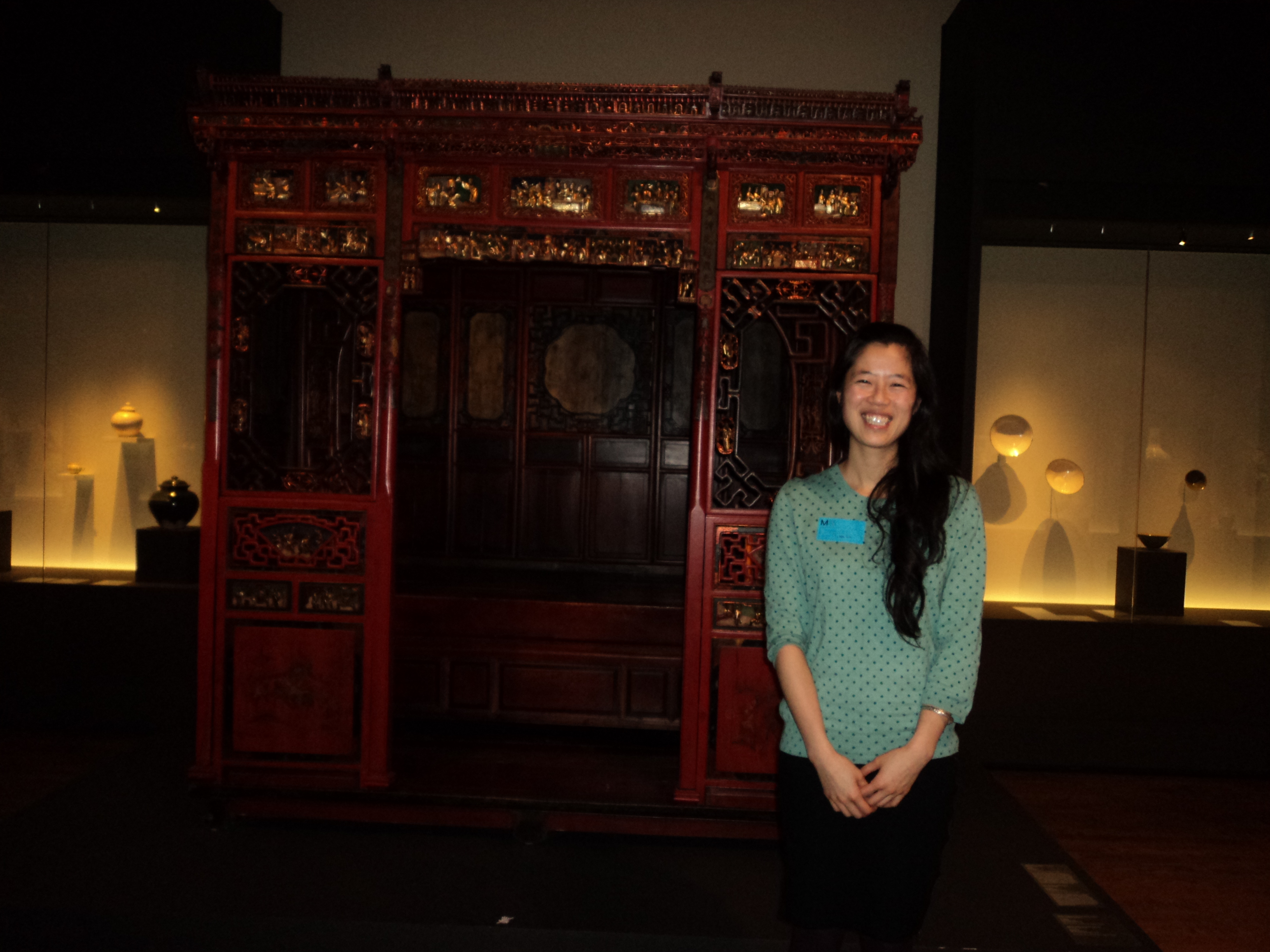
Karen Tam in front of Qing dynasty Alcove Bed at the Montreal Museum of Fine Arts

When my friend Karen Tam, told me earlier this year that she was the artist-in-residence at the Montreal Museum of Fine Arts, I asked her two questions:

1) Do the statues come to life like in the movie A Night at the Museum?
2) What was she doing there?

So maybe my imagination is fueled by movies including Indiana Jones and more recently, Monument Men, and maybe I was disappointed that the answer to my first question was “no,” but I found Karen’s project to be very intriguing.

I met her again on the last day of her residency, this time at the museum, to find out exactly what she was working on. She had spent six weeks exploring their archives and learning about the history of the museum’s collection of Chinese art and artefacts. It was late Friday morning, and we sat on a vinyl bench on the third floor where only a handful of people were perusing the display cases.

Many of the objects she examined came from antique dealers in New York, Boston and London, two of who obtained valuable artefacts because of major historical events. Goods belonging to Japanese-Americans who were interned during the Second World War wound up in the hands of Yamanaka Sadajirô and his company Yamanaka & Co which dealt in government confiscated goods. The other one was C.T. Loo.  Treasures that once belonged to the Chinese Imperial Family fell into his hands as they sold what they could in order to flee China before the fall of the Last Emperor and the Japanese invasion. Accused of being a thief and looter of China’s national treasures, Loo defended himself by saying he was actually saving the art by selling them to collectors.

It seems that the museum also played a small part in history. In the 1940s, the museum held three exhibits by Chinese artists of which one was to raise money for China’s Nationalist Party and another for China’s Communist Party. However, all three exhibits were held when Canada’s Chinese Exclusion Act (which banned Chinese immigrants from entering the country from 1923-1947 )was still in force. Canadian society, while appreciating the art and culture of the Far East, did not hold the same appreciation for the people who created it.

The museum’s Chinese collection holds many stories, but as Karen’s residency ends her interest does not. She is holding talks with the museum about the possibility of holding an exhibit based on her discoveries. In the meantime, her next installation will be at the Mendel Art Gallery in Saskatoon as part of the exhibition “Convoluted Beauty: In the Company of Emily Carr,” at the end of June. Her subject will be Lee Nam, a Chinese immigrant to British Columbia, who was a painter and a friend of Emily Carr. In collaboration with Montreal-based painter, Lui Luk Chun, a senior artist in his seventies, she will re-imagine what Lee Nam’s studio looked like in the 1930s.

You can read more about her experience as artist-in-residence at the Montreal Museum of Fine Arts on her blog Pumpkin Sauce. Check out her portfolio at http://www.karentam.ca.

Click on the link to learn about the artist’s residency at the Montreal Museum of Fine Arts.

Lion Heads waiting to welcome 2014

Enter the Lions – Welcoming the New Year Chinese Style

The pounding beat of a drum, the clash of cymbals and the sound of firecrackers rang through Montreal’s Chinatown Sunday afternoon to scare away evil demons. The lions had arrived to celebrate the New Year. The lions are members of The Montreal Chinese Lions Dance Club, a martial arts and lions dance club. Dressed in colourful, shimmering costumes, they visit stores, restaurants and tong associations in Chinatown to wish them luck and prosperity in the New Year.

Thank goodness the deep, freezing cold temperatures broke this weekend. It was a balmy -1 Celsius. The snow was turning to slush. A small cloud of smoke billowed as firecrackers exploded in Sun Yat-Sen Square. The lions bowed and pranced in front of guests of honour, each of whom dangled a head of lettuce and a red envelope from a pole.  According to tradition, the lion eats the lettuce and the envelope. Then, it tosses the pieces of lettuce in the air to wish the person and the establishment prosperity in the coming year.

The crowd followed the lions up Clark Street to their first stop. Someone on the second floor dangled a head of lettuce and a red envelope from a pole high over the sidewalk. The lions leaped and danced and successfully grabbed both items.

Le Cristal was packed with customers having dim sum when the lions made their entrance into the restaurant located on the sixth floor. Cameras and cell phones snapped photos as the lions wound their way around the tables and headed towards the far end. The owners hung the lettuce and red envelope from the ceiling which was more of a challenge since it was so high. Customers cheered as the lions made several attempts and then burst into applause when they succeeded.

For the next three hours, the lions made their way into shopping centers and stores. They stopped at doorways marked by a head of lettuce and a red envelope hanging from the top, or where someone waited with a pole. The crowd grew as the small parade made its way along La Gauchetière Street, chasing away evil spirits to ensure the community a happy and prosperous new year.

The Red Envelope – Guidelines on giving Lai See

When I was a kid, one of the best things about Chinese New Year was the red envelopes my parents and their friends gave me. Tucked inside the small decorated envelopes was one or two dollars or maybe even five (a fortune in those days). Now as an adult, I’m expected to give out red envelopes. The rule, as my parents had explained back then, was to give money to children and anyone who was unmarried, (usually to someone no older than 25). Society has undergone a huge shift since then and the rules have become blurred, but thanks to Molalacompany.com this guideline makes everything perfectly clear.

Guidelines on Giving Lai See on Chinese New Year

How to Order a Chinese Meal

With the holidays approaching, there’s going to be alot of getting together with friends over brunch, lunch and supper. So, I thought I’d post an article I wrote about ordering a meal in a Chinese restaurant that was published in the Oh Canada! column in the October 2002 issue of Canadian Living magazine.

Bon appétit! Or should I say Chin Chin!

* * *

When my father was alive, we celebrated holidays and birthdays with family dinners in Chinatown. Combined with my older brother’s and sister’s families, we would commandeer the largest table at our favourite restaurant.

While we buried our heads in the menus, my father would sit back, cross his arms and seem to stare off into outer space. When the waiter arrived, we would shout out our favourite dishes by their numbers on the menu.

When it was my dad’s turn, he would ask about dishes that weren’t on the menu. The waiter would brief him on the delicate flavouring of duck tongue, fried intestines and stewed tripe. Any mention of bitter melon fermented with black beans would make my father’s mouth water. “But they would never eat it,” he would mourn with a nod in our direction, and sadly order something for us with beef, pork or chicken. After scribbling characters onto his notepad, the waiter would shuffle off to the kitchen. My dad would turn to us with a sigh of dismay, and say, “You don’t know how to eat!”

According to him, the best dishes were not printed on the stain-speckled plastic menus the waiter tossed onto the table; they were written on the white, pink or red sheets of paper that adorn the walls of many restaurants in Chinatown. Black brush strokes list delectable dishes that are unfamiliar to the North American palate. Being Canadian-born, I always felt that ordering a meal off the wall required special skills to crack the secret code – like Indiana Jones reading hieroglyphs. If only I had made it past Grade 1 in Chinese school.

When the waiter returned with part of our order carefully balanced along the length of one arm, my dad would lament the predictability of his Canadian-born children and grandchildren. Cantonese chow mein and lemon chicken were mainstays at our every meal. Oh, we enjoyed traditional dishes, such as Eight Enhancement Soup, chicken boiled in soy sauce and Cantonese lobster, but it was the writing on the wall that separated immigrant from Canadian-born Chinese.

“What is it?” I would ask when an unrecognizable dish found a spot on the crowded lazy Susan in the centre of our table.

“Oh, good stuff,” my dad would say, glowing in anticipation of eating his choice dish. “Nothing you like.”

I would eye it suspiciously and sniff its aroma. I would interrogate my father and the waiter on the ingredients. My dad would grunt his displeasure at my behaviour. Was this really just about the food, or had I missed the cultural boat by ordering from the wrong menu?

My Canadian-born Chinese friends also back away from the wall when we dine together. And if the waiter reads the specials off the wall in Cantonese or whatever is his native dialect that ultimately brings up another embarrassing point: we can’t understand Chinese either.

“Can’t read and can’t speak?” a waiter once exclaimed, echoing our parents’ disappointment. “Lemon chicken!” he sang out in heavily accented English as we slowly sank under the table in embarrassment.

My father passed away several years ago, and, though our families still gather for special dinners, the ones in Chinatown are less frequent. On those rare occasions, it’s my brother who – with the waiter’s help – ventures to order off the wall.

When an unfamiliar dish arrives, I still look at it with suspicion. But you know what? I really like lemon chicken.